Paperless billing incentives are a tactical way to increase signups to your energy utility’s eBill or paperless billing program. In addition to engaging customers, incentives drive higher click-through rates (CTR) and conversions for eBill campaigns. 

What are paperless billing incentives?

Paperless billing incentives can vary, ranging from high-value prizes like tickets to a sports game or smaller giveaways for every customer who signs up for eBilling (for example, LED light bulbs and gift cards).

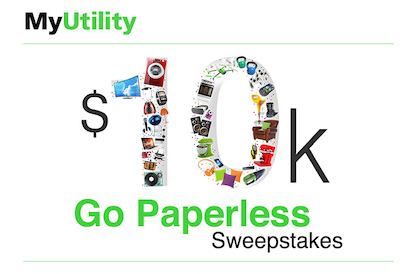
Example of Paperless Billing Incentives ad for sweepstakes

Questline Digital data shows that paperless billing promotional emails with incentives have a 17% higher open rate and 28% higher CTR than messages without incentives. Customers enjoy having the opportunity to earn prizes, especially after learning about the many benefits of paperless billing.

Still, even after identifying the right incentive, it can be daunting to build a campaign strategy that maximizes conversions.

Success starts with a subject line

An incentive-focused paperless billing email begins with an effective subject line that clearly explains the offer. If the giveaway is immediate, let your audience know by using language like “Claim your reward now.”

Follow these subject line best practices for paperless billing incentives:

  • Subject lines that clearly state the incentive reach 13% more of their intended audience compared to subject lines that only imply an offer.
  • Subject lines with “We’ll Pay Your Bill” in the title drive high open rates, but fewer click-throughs.
  • Conversely, subject lines with the word “free” typically do not perform well. This word is often associated with spam.

High-ticket prizes vs. low-cost giveaways

It’s best to test high-ticket and low-cost paperless billing incentives to see what resonates most with your utility’s customers. Consider having a mix of promotions included in your campaign strategy to connect with different customers and vary the giveaways.

Keep in mind that bigger paperless billing incentives do not necessarily mean bigger engagement. While large-dollar-amount prizes drive customer interest in opening promotional emails, that enthusiasm can sometimes be diminished through the contest-entry process.

The “cost” for entering into the drawing is an immediate conversion into paperless billing; this can create an unequal transaction where your customers are asked to give up paper bills for a small chance to win a reward.

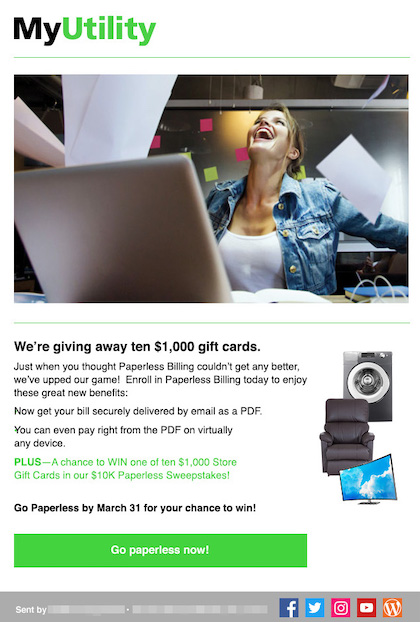
Example of Paperless Billing Incentives with Gift Card Contest

In comparison, we’ve found small incentives are often more effective because they have an immediate, guaranteed payoff. According to Questline Digital data, compared to a contest to win one big prize, small incentives for every customer have a 13% higher open rate and 82% higher CTR.

Based on an analysis of the paperless billing incentives campaigns deployed by Questline Digital, we have found:

  • Awarding a $5 gift card to all signups converts better than enter-to-win contests of $1,000 or more.
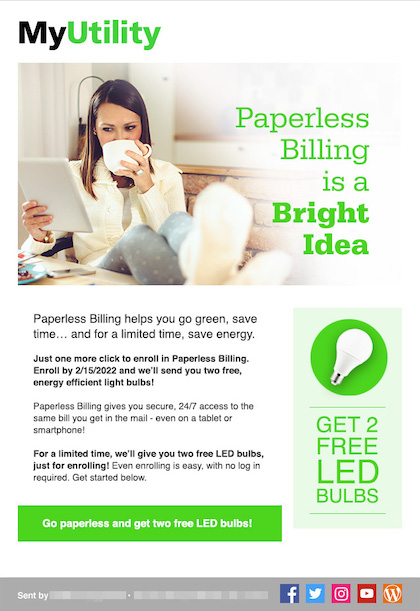
  • Products like LED light bulbs rank second among the best drivers of click-throughs.
  • Thermostats and smart home device giveaways are also top performers.
Example of Paperless Billing Incentives with LED giveaway

Make incentives easy to earn

Making the process easy to sign up for paperless billing is key to increasing conversions. In fact, one-click opt-ins into paperless billing programs increase conversion rates by 22%.

It should be equally easy to earn paperless billing incentives. Customers will appreciate a simple, one-click process to enroll in paperless billing, but the immediate question following signup is, “When will I get my prize?”

Make sure your utility is prepared to answer this question in detail. Share next steps with customers, including if you need to receive their mailing address for prize delivery, if they need to print a coupon or any other steps needed to redeem their incentive.

Make this process just as simple as enrolling and your customers will wonder why they didn’t make the switch sooner.

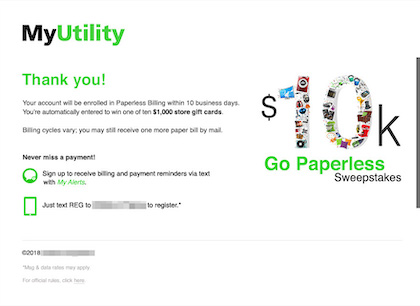
Example of Paperless Billing Incentives sweepstakes entry message
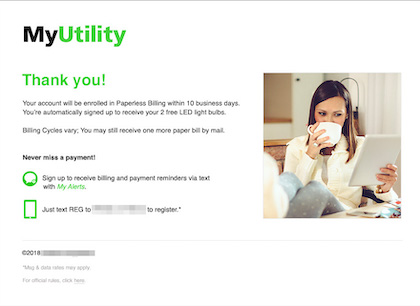
Example of Paperless Billing Incentives thank you message

The power of paperless billing incentives

Everyone likes free things. By offering paperless billing incentives to encourage conversions, customers are more likely to embrace the benefits of eBills.

Paperless billing incentive campaigns are also a great way to encourage re-enrollment from customers who may have unenrolled from past eBill programs. Maybe they unenrolled by accident or didn’t quite understand the benefits. Either way, an incentive-based campaign can be a perfect re-introduction.

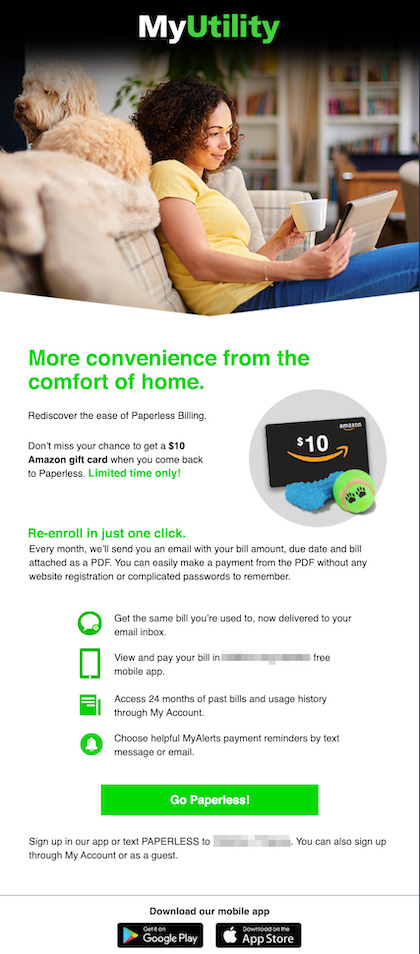
Example of Paperless Billing Incentives with Amazon Gift Card

Incentives provide a massive return on investment for energy utilities, saving operational costs every month for every paperless customer. That’s what we like to call a win-win.

Drive more paperless billing conversions with a digital engagement strategy from Questline Digital.

When it comes to paperless billing, there are many reasons why customers choose to make the switch from paper to electronic bills. According to eMarketer, three in four adults across all generations will switch at least one bill to paperless in the next year. Knowing the right paperless billing benefits to promote — and how to promote them — is essential to creating successful campaigns for your energy utility.

What is paperless billing?

Paperless billing, also known as ebill, is when a customer receives an electronic bill rather than a paper bill in the mail. These paperless bills are typically emailed to customers and available within their online accounts to access and review. Many customers can set up automatic payments through ebilling.

Benefits of ebilling to customers

Paperless billing is a convenient way for customers to access, pay and store their bills. Furthermore, ebilling allow customers to pay their bills directly online, rather than needing to mail a payment or travel to a customer service center. It also allows customers to have easy access to their billing history without the paper clutter at home.

There are numerous advantages of paperless billing, including:

  • On-the-go convenience
  • Pay anytime, anywhere
  • Save money on stamps and envelopes
  • Reduce paper waste
  • Security

On-the-go convenience

For energy utility customers, convenience is perhaps the number-one reason to enroll in paperless billing. Instead of waiting for a paper bill in the mail, customers can quickly access their bill from their email inbox. Paperless billing fits into customers’ busy 24/7 schedules and helps reduce stress.

Flexible payment options add to the convenience. Ebill customers have access to numerous payment options, including through a bank account, debit card, credit card, autopay, mobile app and even smart home voice activation. When thinking about their bills, consumers say late payments are a top concern. That’s why energy utilities should promote the benefits of email and text payment reminders in their paperless marketing.

Pay anytime, anywhere

The ability to access your bill from any location is a top benefit of paperless billing. According to Questline Digital’s Energy Utility Benchmarks Report, 68% of residential customers engage with program promotions on a mobile device such as a smartphone or tablet.

A survey of smartphone owners finds 42% pay their monthly bills through a mobile device. In addition, millennials and consumers with a household income between $50,000 and $99,000 are more likely to use mobile bill pay. As this data demonstrates, energy utility customers want the flexibility of viewing and paying their bill on the go.

The COVID-19 pandemic aided in this “pay anytime” value proposition as consumers looked to budget their bills amidst other financial concerns. Instead of emphasizing the on-the-go benefits, highlight the 24/7 convenience of paperless billing. For example, customers can pay their bill in the middle of cooking dinner, doing a home workout or watching Netflix.

Saving money

For business customers in particular, paperless billing has a major impact on operational costs. Compared to residential consumers who receive about 12 bills total each month, small businesses receive about 50 bills on average.

Traditional paper bills require a constant supply of postage and envelopes or time spent logging into numerous sites to make payments. For small and large businesses alike, paperless billing reduces costs and increases productivity. With an overload of paper transactions in everyday business operations, electronic bill statements are one less piece of paper to keep track of each month.  

Reduced paper waste

Utility customers are increasingly concerned about the environment. In fact, 87% of consumers view a company favorably that supports the environment, whether through programs, products or philanthropic efforts.

To reach the eco-conscious consumer, emphasize the benefit of generating less paper waste through ebilling. Paper is a major concern, making up 26% of landfill waste, 33% of municipal waste and 50% of business waste. Customer can see this benefit in their own homes, when fewer snail-mail bills results in less clutter and fewer trips to empty the garbage or recycling bin.

Security

When it comes to paperless billing benefits, a top priority for many customers is security. How is their information stored? What will it be used for? Will their account be safe? Although digital methods can present their own concerns, the truth is that paper statements are not free of fraud risk. Mail can be intercepted, misplaced or fall into the wrong hands, leaving valuable account information or even payments unprotected.  

Paperless billing, on the other hand, accounts for these concerns by implementing security measures and protocols for customers’ login information. Even if bills or account information is emailed, it will never contain full account information, which gives extra protection if a customer’s email was to be compromised.

It’s important to share how your utility puts security measures in place and the lengths it goes to protect customers’ sensitive data. Customers want transparency, especially when it comes to their personal information.

Fiserv surveyed respondents on the security of payment methods and found that consumers’ confidence in the security of specific digital channels, including financial mobile apps and digital wallets, increased significantly from 2018 to 2019. This highlights a move forward as customers acknowledge the safety of ebilling and grow more comfortable with the technology.

Paperless billing benefits for energy utilities

Paperless billing doesn’t just offer benefits to customers. On the contrary, the effects of ebill are positive for customers and energy utilities alike.

Utilities experience a variety of advantages of paperless billing, including:

  • Decreased call center traffic
  • Reduced postage costs
  • Improved payment speed
  • Boost in customer satisfaction
  • Increased customer engagement

Decreased call center traffic

According to Energy Central, many utilities handle around 1.4 million live calls per customer per year. Typically, these calls are made up of:

  • 30% to 40% payment arrangements
  • 5% to 15% payments
  • 25% to 35% billing

What’s more, statistics show that many of these calls come from the same customers. This means they continue to have the same questions with payment arrangements or billing. With paperless billing, call levels can be dramatically reduced as these customers learn to use self-serve options for their payment and billing needs.

Although call center traffic may never completely diminish, promoting paperless billing benefits to customers in a way that acknowledges the typical help they need — such as how to make a payment or view their bill — will lessen their need to call for help. 

Reduced operational costs

In addition to reduced paper waste, another paperless billing benefit is simply a decrease in costs for your energy utility. When your utility no longer has to mail paper bills, it also no longer has to buy paper, envelopes, or most importantly, stamps. This is especially important to consider as postage prices continue to rise.

In August, the price of a first-class Forever Stamp went from 55 cents to 58 cents. Although at first glance it appears the increases are minimal, it quickly adds up when the number of customers requiring paper bills each month is taken into consideration.

Plus, paperless billing saves money from any bills lost in the mail or resending bills to customers that have moved. Ebilling alleviates these cost concerns and allows your utility to put that money toward other customer-centric programs.  

Improved payment speed 

Another paperless billing benefit for energy utilities is the improved payment speed and increase in bills paid. The conventional methods of processing paper-based payments are time-consuming, from the time it takes a customer to receive their bill until the payment is received by the utility.

Regardless of industry, studies have found that customers often pay bills later when sent by mail compared to bills sent electronically, making paperless the preferred method of billing in the financial suite of most organizations.

Overall, paperless billing drastically speeds up the revenue cycle. Since customers have access to their bills anytime, anywhere, they can make payments instantly from their smartphone or laptop and are immediately notified when bills are available to view.

Boost in customer satisfaction

Paperless billing means customers have the convenience of viewing their bills and managing their accounts anywhere, anytime. According to a Fiserv household survey, 75% of customers say paperless billing helps them better manage their finances. 

Ebilling also leads to increased awareness of all digital messaging, allowing your utility to get closer to a seamless customer experience. In addition, the option to go paperless tends to improve customer satisfaction. According to Fiserv’s Eighth Annual Consumer Billing Household Survey, an impressive 68% of paperless consumers acknowledge increased satisfaction with their biller when they receive electronic statements.

Specifically, Southern Company Gas found that customers who receive ebills are 21% more satisfied than those who receive paper bills, according to company-conducted surveys. Utilities that promote paperless billing benefits and encourage ebilling adoption can see positive increases in customer satisfaction and J.D. Power ratings as well.

Increased customer engagement

A final paperless billing benefit is an outcome that all utilities hope for: increased customer engagement. While it’s already been noted that paperless billing improves customer satisfaction, ebilling also provides opportunities to increase engagement across multiple channels.

Since most utilities include ebilling within customers’ My Account portals, this is a great way to provide education or encourage engagement with other programs and services your utility offers. For example, when highlighting a customer’s energy use within a bill, link to your energy efficiency tips and resources page.

Do your utility’s customers choose paperless billing? Learn how Questline Digital’s proven solution can help.
For energy utilities, encouraging customers to adopt energy efficient lifestyles is an ongoing challenge. Both residential and business customers benefit from reducing energy, but it can be easier said than done to change long-standing behaviors. However, with the right strategies in place, utilities can make strides in their energy efficiency adoption goals.  

In our latest webinar, “Energy Efficiency Adoption Solutions,” Colleen Bullett (Questline Digital), Laurel Gerdine (Franklin Energy) and Mary Medeiros McEnroe (Silicon Valley Power) discuss the importance of EE adoption and how to promote energy-saving solutions to your customers.

Bullett kicked off the webinar with a round of statistics, including: In 2019, the average annual electricity consumption for a U.S. residential utility customer was 10,649 kWh, an average of about 877 kWh per month.

In addition, Questline Digital’s 2021 Energy Utility Benchmarks Report finds that customer interest in energy efficiency increased significantly throughout the pandemic. In fact, customers engaged with promotional emails from their utilities at an 18% higher open rate and 27% higher click-through rate.

According to Bullett, there are many reasons to convert utility customers to energy efficient lifestyles, notably environmental and economic benefits. EE adoption plays a powerful role in lowering greenhouse gas emissions, reducing utility bills, creating jobs and addressing energy equity. With an aggressive commitment to energy efficiency, utilities could help reduce U.S. carbon emissions by 57% by 2050.

“It’s more cost-effective and efficient for energy utilities to encourage customers to change energy patterns instead of spending money on new technologies, updating generators and other costly measures,” Bullett says.

Research finds that 56% of consumers find it “very important” to have an energy efficient home. However, only 9% of those consumers think their home is energy efficient. Moreover, 47% customer say “the money I can save” is a top indicator of whether they will purchase energy efficiency products or not. Environmental concerns drive 44% of customers to invest in energy efficiency.

These are the top reasons why customers are averse to adoption:

  • “The costs are too high”
  • “Unsure about real-world benefits and performance”
  • “Too many barriers to adoption”
  • “Waiting until others adopt first”

To overcome these barriers, Bullett recommends sharing success stories in the form of case studies and content marketing. These solutions address the knowledge gap and help customers to better understand home energy audits, time-of-use (TOU) rate plans and other programs. Energy utilities should use content marketing to encourage customers to change behaviors, such as charging their electric vehicles at night or installing ENERGY STAR appliances. Content marketing is key to showing customers how they can easily implement these changes into their everyday lives.  

With a large base of commercial and industrial (C&I) customers, Medeiros McEnroe shared how Silicon Valley Power promotes energy efficiency programs to this hard-to-reach audience. The municipal electric utility, located in Santa Clara, California, has over 40 large data centers and numerous tech companies in its 18.4-square-mile service area.

Residential customers make up about 85% of the utility’s customer base, but only represent 6% of energy usage. That’s why Silicon Valley Power focuses its energy efficiency efforts on C&I customers. Medeiros McEnroe reinforced the importance of understanding your business customers in order to promote the right energy efficiency technologies.

Energy utilities need to ask the right questions:

  • Are they a local, regional or national company?
  • What do they do?
  • What are their business drivers?
  • What are their pain points?
  • When are their funding cycles?
  • Do they have metrics for decision-making?
  • Who are the energy champions at the organization?

When energy utilities reach out to C&I customers, they need to understand the return on investment for an energy efficiency program or technology. In other words, will this solution help increase productivity and improve the company’s bottom line? Medeiros McEnroe encouraged utilities to think beyond how much a business will save on their electric bill. For example, what are their climate goals? What is the ROI equivalent to increased product sales?

To encourage energy efficiency adoption with C&I customers, Medeiros McEnroe recommends using targeted program promotions with multiple touchpoints, including emails, postcards and two-page fliers. Silicon Valley Power also takes advantage of site visits and training with trade allies. When the utility promoted an energy efficiency incentive program with hotels and motels during the pandemic, site visits and trade ally training were key to achieving high program participation.   

In addition to promoting the energy benefits of a particular solution, it behooves energy utilities to talk about the non-energy benefits as well. Medeiros McEnroe shared an example of an energy efficient deep fryer demonstration at the Food Service Technology Center. The energy efficient deep fryer came to temperature faster, resulting in oil lasting longer than traditional fryers. This was quantified by the amount of French fry orders made per year, the amount of oil saved each year, etc. The non-energy savings were significantly more than the energy savings. Medeiros McEnroe strongly encourages quantifying the non-energy benefits of a solution to customers as a way of speaking to what is most important to them.  

It can be just as challenging to encourage EE adoption among residential customers. Franklin Energy, which serves 500,000 residential customers annually, has experienced success with energy efficiency education and promotions. According to Gerdine, the utility’s commitment to energy efficiency adoption has resulted in a reduction of 1.6 million metric tons of carbon emissions in 2020.

To impact program adoption for residential customers, Gerdine emphasizes promoting convenience and simplicity. “We live in an Amazon world and consumer buying motivations have dramatically changed,” she says. An Accenture study found that 57% of consumers would switch retailers if they did not offer new, fast and flexible delivery options. For energy utilities, this means taking a hard look at their processes and determining what needs to change to meet the expectations of today’s customers.

“If you are not providing an easy way for customers to enroll or participate in an energy efficiency program, adoption will not be successful,” Gerdine notes. “Customers expect a streamlined sign-up process – if it’s too complicated, they will simply avoid it.”

For example, Franklin Energy had been using paper applications for years for its home weatherization program targeting low-income customers. The utility recently implemented an online application capability, mostly for use by program allies (the main channel for participation). The results were immediate with 30% to 50% of weekly applications submitted online.  

Another example is the promotion of a large home energy assessment program. During the pandemic, the utility collected Covid-related information in the sign-up process. While the goal was to protect the health of customers and team members, the program execution created a barrier to sign up that significantly impacted adoption. In fact, the added complexity resulted in a 40% increase in the scheduling page bounce rate. To solve the problem, the Franklin Energy team removed the questions and asked them as part of a follow-up process. With this quick fix, the bounce rate returned to normal levels.

“The main lesson here is to make sure you consider the impact of your actions on the sign up process,” Gerdine says. “Remember the old ‘keep it simple’ rule to drive adoption and participation in programs.”

Partnerships are another huge resource to influence energy efficiency adoption. In the midst of Covid-19, community became a huge channel to provide energy efficiency solutions to low and medium-income customers. In addition, the emergence of new program designs and increasing complex technologies has shined a light on the value of engaging communities. Gerdine recommends that energy utilities work with key stakeholders to drive adoption among residential customers.

“It really takes a village to drive energy efficiency adoption and this will continue and become more important moving forward,” Gerdine says. “We began to use new community channels to reach customers where they are.”

Questline Digital can help your utility increase energy efficiency adoption among residential and business customers.

As energy providers look to strengthen relationships with their customers, many are launching utility marketplace websites to sell energy-related products and services.

Energy utility marketplaces are appearing in two distinct categories:

  • Project marketplaces connect customers interested in energy efficiency and home improvement solutions with certified professionals. These marketplaces include installation services for EV charging stations, solar panels and even home security and smart home hubs.
  • Product marketplaces are e-commerce-style websites where customers can purchase smart thermostats, ENERGY STAR® appliances, LED lighting, advanced power strips and other efficiency-related products directly from their energy utility.

Energy utilities face an uphill battle to break through the crowded field of marketplaces dominated by titans like Amazon and Walmart. This competition, coupled with the fact that the average e-commerce site conversion rate is between 2% and 3%, reinforces how energy utilities are fighting for a slim share of a very crowded market.

How can energy utilities break through the noise?

A Trusted Marketplace For Energy Products

Though challenging, energy utilities actually have a few competitive advantages over established e-commerce players.

If you search on Amazon for LED lightbulbs, you’ll find more than 10,000 results. However, there are few recognizable brands to choose from and it’s hard to compare the many features and prices.

Your customers are busy and don’t have the time or patience to wade through the overwhelming number of options.

In comparison, your utility marketplace offers fewer products that have been vetted by your energy utility, ensuring authenticity and reliability.

Customers want a simple recommendation they can trust, and your energy utility can provide that.

What’s Missing From Today’s Energy Utility Online Shops?

Currently, most utility online shops aren’t built to match the e-commerce shopping experience customers have come to expect. Shoppers are used to having an easy-to-use search tool, personalized recommendations, product reviews, linked tutorials, and more. Without these features, online shoppers are apt to jump over to more user-friendly sites.

Most utility marketplaces also lack search engine optimization (SEO). Product listings are not discoverable to consumers and remain reliant on marketing promotions. Yet, promotions have historically been limited to occasional bill inserts and mass messages to all customers.

In order to be successful in today’s crowded smart tech market, energy utilities will need to embrace the advanced marketing tactics used by e-commerce brands.

“Energy marketplaces are really an e-commerce business, and they need to be treated as such,” explains Mark Wilkinson, SVP Products at ibex Digital. “Utilities should really embrace the e-commerce philosophy. It comes down to personalized, timely and relevant marketing. Something that direct-to-consumer brands do very well.”

Driving repeat and regular traffic to utility online shops is now essential. 

How to Market Your Energy Utility Marketplace

In order to fully realize the potential of marketplaces, energy utilities should implement a multifaceted marketing strategy to drive awareness, traffic and conversions.

Here are a few impactful ways to better market your utility marketplace:

Content marketing:  Before making a purchase, customers need to learn about the energy efficient or smart home products in your marketplace. Why do they need them? How do they use them? What are the benefits?

Content is great for boosting awareness and developing interest. Use blog posts, videos, social media and infographics to educate customers on utility marketplace products and how they fit in their daily lives. Share content across eNewsletters, social media and on your marketplace itself.

Incorporate links to related products and calls-to-action within your content to create an organic buying experience. For example, include a CTA to your marketplace in an article about smart home technology or an infographic featuring energy-savings tips. Content marketing leads your customers to the next step naturally.

Be relevant and timely: Purchases are also tied to triggers and events, making relevancy and timeliness key for e-commerce marketing. Get in front of customers when they are making buying decisions.

Capitalize on seasonal changes and holidays; put rebates and product promotions in front of customers when they are most likely to make a purchase.

Behavioral emails: Use scheduled email cadences to encourage action and build a positive customer experience. Build timelines that match customer behaviors.

Let’s say someone bought a new smart thermostat. Send them an instructional email after their shipment is delivered with tips on how to install. Then send an email three or four days later that helps them learn how to take the next steps with program enrollment. If they don’t enroll or open that email, have a reminder sent a few days later. Then in a month, follow up with suggested products that complement their previous purchase.

“We always recommend tackling behavioral promotions in small chunks,” explains Wilkinson. “Offer recommendations and cross-promotions (people who bought this also liked…) and follow-up emails related to customer’s purchases to really help the experience. It doesn’t have to be overly complicated and can lead to immediate results.”

Abandoned cart emails: Emailing customers who have abandoned shopping carts is a successful strategy for driving incremental conversions. By sending an automated message, you can offer additional incentives such as a coupon to complete the sale at a lower cost. These easy-to-implement emails achieve success rates between 27% and 30%.

Audience segmentation: Energy utility customers encompass a vast set of demographics. Understanding the wants and needs of different groups is monumental for utility marketplace promotions.

Let’s say you identify a segment of empty nesters who also have pets. This audience is primed for streaming cameras or security systems that allow owners to check in on their animals.

“Segmentation can really benefit topic and tone for utility marketplace promotions,” explains Wilkinson. “Customers get interested in the same product in very different ways, so understanding the customer personas really helps develop traffic and ultimately sales on a utility marketplace.”

Tie in program promotions: The biggest win for utilities may be tying marketplace sales to program enrollments. For example, when customers are checking out for their smart thermostat, utilities can incorporate prompts to sign up for time-of-use (TOU) rate programs.

Program prompts can be built into the marketplace itself, or they can function more like a follow-up email. Today, consumers expect an effortless shopping experience. Take the extra step to make the connections between products and programs.

Examples of Great Utility Marketplace Promotions

The energy utilities finding success with energy marketplaces are those who actively promote and follow e-commerce standards. Check out these examples:

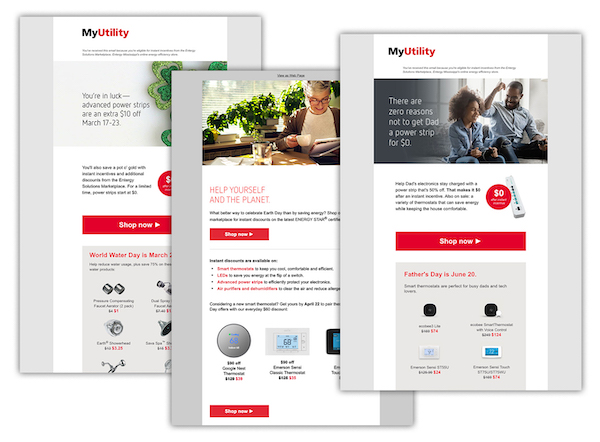
First Energy Home

Experimentation with social media, display ads, content, email promotions and search engine marketing (SEM) has allowed First Energy to build brand recognition for their utility marketplace.

Holiday Promotions

In an effort to be timely and relevant, this Questline Digital client has seen success with promoting its marketplace and product rebates around holidays.

Examples of email marketing promotions for energy utility marketplace

Examples of Great e-Commerce Content

Still not sure how to promote your utility’s marketplace? Pull inspiration from brands that have mastered e-commerce. 

Williams Sonoma is great at using content to sell. Their emails often include how-to cooking videos with links to products used during tutorials. Plus, emails are sent to customers based on previous shopping and site visitation behaviors.

Were you looking at their bread mixes? Then you might receive an email in a few days that highlights their baking and pastry tools, bakeware and easy-to-prepare croissants. It will likely be paired with a supplementary video that provides a few baking tips or links to fan-favorite bread recipes – all the things you might need next after your initial purchase.

Williams Sonoma understands their customers and their buyer journey. The retailer knows that basic purchases tend to lead toward future specialty products.

Similarly, smart thermostats are often the first smart tech product purchased. After an initial trial period, customers who found value in the product tend to expand their smart tech collection.

Take inspiration from brands like Williams Sonoma and build content strategies that ensure your utility is present when customers are ready for the next step. Offer help and guidance.

Be the Trusted Expert for Energy Products

While it can seem like an uphill battle to compete with colossal retailers, energy utilities should use their industry expertise to their advantage.

Your customers trust your energy utility and the products you recommend — and that’s a great place to start when promoting your marketplace.

Complement your competitive advantage with helpful content and timely promotions, and your energy utility will see results.

Learn how to boost engagement and grow sales with an Energy Marketplace Content strategy from Questline Digital.

Ensuring the reliability of your customers’ energy supply is one of the most important jobs for any utility — yet it’s often taken for granted by customers. By participating in commercial demand response programs, business customers will better understand the role they have to play and directly contribute to making the electric grid more stable.

How do energy utilities encourage business customers to participate in demand response? By sharing the benefits of these programs, addressing common objections and offering energy-saving education, utilities can enlist the participation of more businesses and ensure the success of demand response programs.

What Is Demand Response?

Demand response is an effort to manage the capacity of the electric grid during peak events, or times of extremely high power draw. If businesses and households demand more electricity than can be produced — say, during a hot August afternoon when the air conditioning is running full blast — it may lead to outages. Producing more electricity by constructing new power plants can be costly and take years of planning. Plus, it often it means adding more fossil fuel generation to the grid instead of renewable sources.

Demand response programs seek to minimize the impact of peak events and prevent the need for building more power plants. Commercial demand response programs pay business customers to reduce their power draw during peak events, ensuring the stability of the grid for other customers and ultimately reducing the cost of energy for everyone.

How Does Demand Response Impact Commercial and Industrial Customers?

Customers can look at demand response events in two ways: the (potentially temporary) inconvenience of participating and the (potentially detrimental) drawbacks of not participating.

Commercial and industrial customers who participate in demand response programs may be asked to reduce their power draw during peak events. This can lead to minor inconveniences like reducing HVAC use or major impacts like closing the business for part of the day. On the positive side, program participants receive financial incentives that may include cash payments or reduced rates — even if a response event is not needed. The amount of advanced notice varies by program.

Businesses that don’t participate would not receive these incentives, of course, but they still might suffer the negative effects. An unexpected outage during peak events could cause devastating business interruptions. Long term, without effective demand response programs, a utility might have to add more carbon-based generation to the grid and rely less on renewable sources — increasing the cost of energy for everyone.

How to Promote Demand Response Program Benefits

The importance of demand response programs to your utility is clear: Managing the load during peak events is critical to ensure the reliability and stability of the grid. But why are these programs important to businesses? When promoting demand response, the key is to focus on the benefits to your customers, not the benefits to your utility.

Commercial demand response programs benefit your customers in three significant ways:

  1. Financial incentives. Businesses get paid to participate in demand response programs and can benefit from upfront payments, rebates and/or lower energy rates.
  2. Operational planning. Program participants can prepare for demand response events and ensure smooth transitions. It’s much better than being caught off guard by unexpected outages.
  3. Green reputation. Businesses are partners with the utility in ensuring a cleaner and more stable energy supply for their community — which both employees and consumers appreciate.

Overcoming Common Hurdles to Demand Response Program Adoption

Despite these benefits, commercial and industrial customers may be wary of demand response programs. After all, reducing power draw could be a significant interruption to business operations. It’s important for energy utility marketers to acknowledge these objections and clearly address customers’ concerns.

Make it easy to participate. The thought of interrupting business operations or reducing power draw at a busy commercial facility may be overwhelming. Help customers participate, and demonstrate how easy it is, with clear guidelines and processes for demand response events.

Share testimonials. Who knows the benefits of demand response programs better than current participants? Look for success stories among your customers and capture video testimonials to share with businesses that are considering the program. Spoken in their own words, such videos are authentic and relatable to other business customers.

Segment messages by new/returning customers. If you require past participants to sign up for your demand response program each year, it’s important to remind them of the benefits even though they may already understand the program. New prospects, on the other hand, will require a more detailed explanation and may need repeated outreach.

Segment messages by industry. Reducing power draw during a demand response event will affect a healthcare facility much differently than, say, a factory or warehouse. It’s important to address each industry’s specific concerns with a segmented communication strategy and offer relevant participation advice for each type of facility.

Examples of Effective Commercial Demand Response Promotions

Commercial demand response programs may seem complex or intimidating to potential participants. It’s not enough to simply market the benefits of these programs with a typical campaign. Demand response promotions need to include a healthy dose of education to fully explain how the program works, the benefits of participation, and advice about compliance, including industry-specific efficiency information.

Questline Digital produced a comprehensive campaign for a major IOU in the Midwest to promote its demand response program. The campaign was a success, exceeding the utility’s participation goals and reaching customers in multiple channels with a variety of content formats:

  • Website landing page with full program details and benefits
  • Video testimonials from current participants
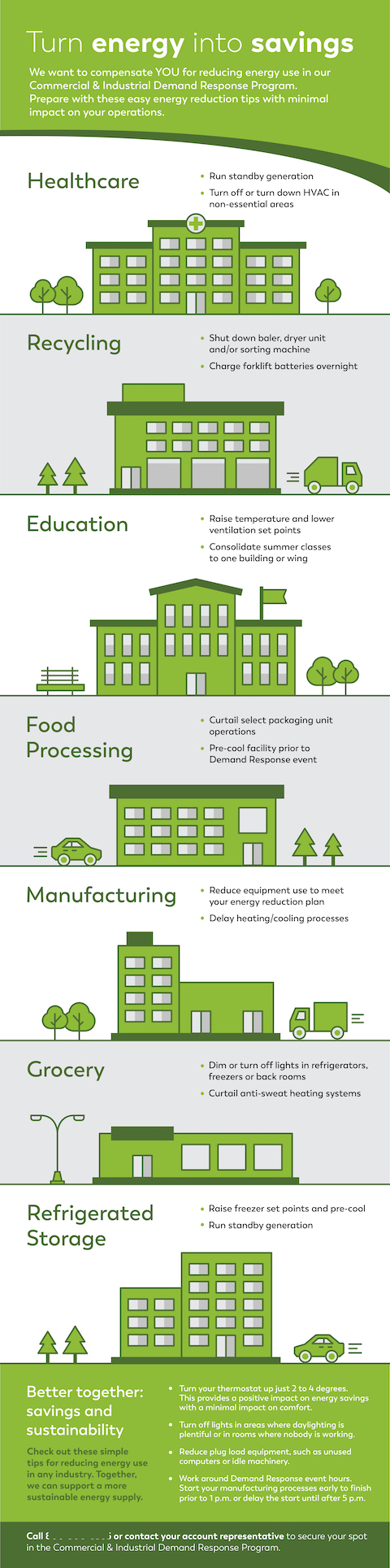
  • Infographic with energy-saving advice
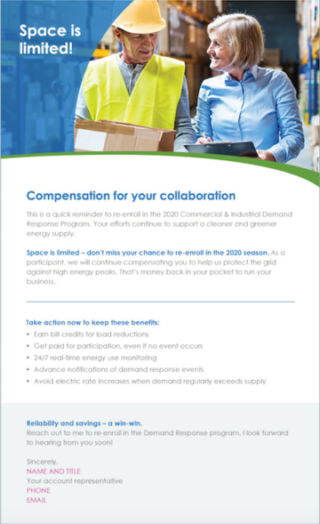
  • Email campaigns to past participants and prospective new participants, including behavioral follow-up messages to both audiences
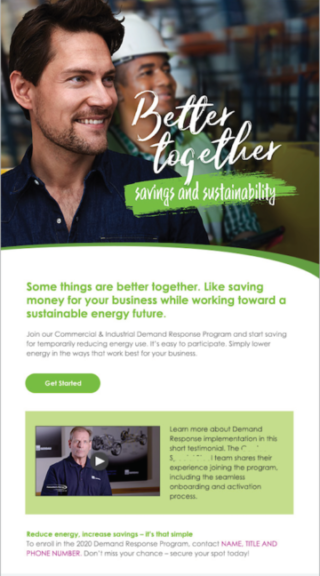
Example of email promotion for commercial demand response program

Business customers have an important role to play in maintaining the reliability of the electric grid. In addition to financial benefits, demand response participants can be proud of partnering with their utility to ensure a cleaner and more stable energy supply for the entire community.

Learn how to promote the benefits of your demand response program with a digital engagement strategy from Questline Digital.