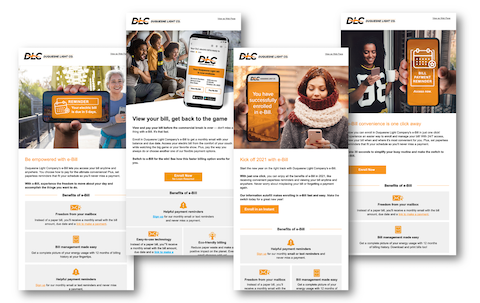
Don’t sleep on welcome emails. They are one of the most effective forms of marketing automation you can set up. Here are a few reasons why…

  • The average open rate for welcome emails is 60.3%, which makes them 114% more attention-grabbing than standard emails.
  • Compared to regular email marketing, welcome emails make 320% more revenue on average.

When a customer signs up for service, they subconsciously seek acknowledgment. They want you to greet them upon their arrival. Remember the saying, “Great hosts greet their guests” and apply the mentality to your emails.

But alas, no one will open your message unless your subject line inspires them to. Here’s how to craft a compelling welcome email subject line that encourages opens.

3 Rules for Writing Great Welcome Series Subject Lines

Don’t overthink your welcome email subject lines. Straight-forward messages perform best. Follow these basic rules and you’re sure to catch attention.

  1. Use a simple hello, hi or howdy. Make it obvious what your message is all about. Your customers just signed up for utility services and are expecting to receive onboarding information. Make them feel welcomed.
  2. Offer a discount or immediate value. Give customers a specific reason to open your email. Include rebates, incentives or other benefits that customers can take advantage of right away. Make your value apparent.
  3. Suggest next steps. Include instructions, a CTA or action verbs to spell out what you want customers to do with the information you’re sending. Make it so they can’t miss the important stuff (like billing).

Best Performing Welcome Email Subject Lines

Check out the top-performing welcome series subject lines, pulled from Questline Digital’s industry-wide marketing performance data. Each example follows the tips outlined above and successfully compels customers to act.

Subject LineOpen Rate
Explore your billing and payment options94.7%
The power is in your hands94.1%
Welcome to [Utility Name]94.0%
[Utility Name] is here to help you93.3%
Billing and payment options – made easy91.7%
Convenient billing options for your business90.1%
Welcome to the [Utility Name] family!87.9%
Let us help you manage your energy costs85.7%
Account and billing options you need to know85.3%
3 outage resources you need to know about84.2%

What to Include in Your Welcome Series

An effective welcome series includes three to five emails. That’s why you’ll need multiple welcome email subject lines within your onboarding series. Lucky for you, that means you can test which topics and words garner the most attention.

Whichever way you choose to organize your welcome information, common topics include:

  • My Account set up
  • Billing options
  • Available discounts or rebates
  • Outage resources
  • Community involvement
  • Energy efficiency resources

Don’t make it overly complicated! Provide your customers with what they need and make it obvious what you’re offering or asking them to do. Remember, new customers want to hear from you. An effective welcome series should be the start of long-lasting — and highly satisfied — digital relationship with customers.

Learn more about Questline Digital’s proven solutions to build digital engagement with new utility customers.

No matter the brand, first impressions with new customers are everything. That’s why a great welcome message is essential in every industry, from retail to hospitality and everything in between. For the energy utility industry, an effective welcome email design has the power to increase customer engagement, drive program promotion conversions and build long-lasting satisfaction.

According to Questline Digital’s 2022 Energy Utility Benchmarks Report, 60.2% of Welcome Series emails were opened by customers in the past year — the highest engagement rate in Benchmarks history. Welcome Series also experienced a high CTR of 11.9%. A great welcome message sets the stage for successful digital customer relationships and provides a valuable introduction to your energy utility.

Welcome Email Design Best Practices

Welcome emails are the first digital interactions customers have with your energy utility. Typically, these communications are saved by customers and make a great point of reference. Your welcome email design should give customers exactly what they want and need. Set the precedent for the value they will receive by opening and reading the email.

“This is the introduction of your energy utility — that’s why it’s vital to think long-term,” says Joe Pifher, Questline Digital’s Creative Director. “Keep your branding as evergreen as possible. Once you have a good formula for the content in your Welcome Series, there’s really no reason to change it.”

According to Pifher, a great welcome message should incorporate these best practices:

  • Include more detailed information than a standard email.
  • Divide topics into sections for easy reading.
  • Use icons to help customers find topics at a glance.
  • Stay as true to your utility’s brand as possible.

“As with any communication, keep your email clean and easy to read,” Pifher explains. “Bucket topics together so they are easy to find when customers are skimming the content. I also suggest using icons to help with a quick search.”

Pifher also recommends these basic principles for welcome email design:

Think about accessibility: To ensure ADA compliance, add alt tags to all images. In addition to tagging, use a Web Content Accessibility Guidelines (WCAG) checker to make sure fonts and color contrast are readable for vision-impaired customers.

Use live text: If your hero image includes a headline, live text makes this copy visible if a customer has their “images” turned off. With live text, these customers aren’t missing important information.

Be mobile-ready: Mobile-optimized welcome email design is essential today. In fact, more than 63% of residential customers read emails from their energy utility on smartphones.

Be aware of dark mode: Many customers prefer dark mode, which helps reduce visual strain. Multiple surveys show that over 80% of consumers use dark mode on one or more applications.

To give your energy utility some inspiration, check out these welcome email samples for new customers from a wide variety of industries.

Welcome Email Design #1: Thrive Market

Thrive Market, an e-commerce retailer offering natural and organic food, begins its welcome email with a short letter from the co-founder and CEO. The letter speaks to the brand’s focus on health and sustainable living, which resonates with its target audience of eco-friendly consumers.

The welcome email design provides customers with a quick snapshot of resources to begin their journey with the e-commerce site, including an FAQ section, helpful health tips and recipes, and how to shop their exclusive products. Thrive Market also highlights their company’s efforts to make a positive impact on the planet, such as becoming a 100% carbon-neutral company.

Takeaway for energy utilities: Based on this welcome email sample for new customers, the first email in your Welcome Series is a good spot for a short letter from your energy utility’s president. In your welcome email design, you could also include a message from a lineworker, giving the email a neighborly feel. Similar to Thrive Market’s approach, consider sharing helpful energy efficiency tips and promote your marketplace.

Welcome Email Design #2: Airbnb

Airbnb’s welcome message makes it easy for new customers to understand how the vacation rental company’s service works while providing imagery of enticing destinations and travel inspiration.

This great welcome message outlines what a customer can expect when booking a stay with Airbnb, including host verification, secure payments and cancellation policies. It also provides links where customers can learn more about the company and visit the Help Center.

Takeaway for energy utilities: Incorporate Airbnb’s educational approach into your welcome email design by providing customers with clear and easy-to-understand information about your energy utility’s programs and services.

Make it as easy as possible for your customers to enroll in My Account, paperless billing, outage text alerts and other essential services. Also, be open about what customers can expect from your energy utility, such as transparency and quick response during outages.

Welcome Email Design #3: Apple TV+

Apple sends out a welcome message to new Apple TV+ subscribers. This welcome email sample for new customers provides a brief overview of the streaming service and shares popular movies and series to encourage subscribers to start streaming. The email also promotes the Apple TV app, which makes it easy for subscribers to watch their favorite shows from any mobile device. The simple welcome email design features concise messaging, which resonates with today’s on-the-go consumers.

Takeaway for energy utilities: Energy utilities benefit from a clean welcome email design and straightforward messaging. Copy should be short and sweet while providing customers with a relevant overview of your energy utility. Instead of including too much copy in one email, provide a short description and link to your website for more information.

We see success with an average of four emails per Welcome Series campaign. This approach allows your energy utility to deliver information in smaller, targeted pieces over time, rather than one overly long email. Like Apple, your energy utility also has the ability to share recommendations, such as popular products from your energy utility’s marketplace.

Welcome Email Design #4: Lush Fresh Handmade Cosmetics

In this welcome email sample for new customers, the beauty retailer Lush shares product recommendations, encouraging customers to shop online. The welcome message also explains how customers can interact with the brand through product tips and behind-the-scenes videos on social media. The welcome email design utilizes vibrant, colorful images that showcase the brand’s fun personality.

Takeaway for energy utilities: Energy utilities might not have as bold of an image as a beauty retailer like Lush, but that doesn’t mean you should shy away from showing off your brand personality. For a great welcome message, consider sharing what makes your energy utility a cornerstone of the community, such as philanthropic efforts, employee volunteerism and other involvement.

To capture attention in your welcome email design, take advantage of eye-catching imagery, such as photography of people that reflect your service area’s demographics. Your energy utility could also incorporate actual photos of your lineworkers restoring power or employees volunteering in the community.

Welcome Email Design #5: The Glenlivet

The Glenlivet, a Scotch whisky distillery, takes a personalized approach to its welcome message. The eye-catching welcome email design is casual and conversational in tone, with the bold headline, “Hey There, Whisky Lover.” Perhaps most unique, customers have the opportunity to “create their own adventure” by choosing how they take their whisky. This fun quiz-style email directs them to an alcoholic beverage that is best suited to them.

Takeaway for energy utilities: Energy utilities can increase engagement in their Welcome Series by personalizing the content to residential or business customers. You can further customize your welcome email design with segmented content for new customers and existing customers who recently moved within your service area.

When promoting energy efficiency programs, consider two different messages for homeowners and renters. These audiences have distinct needs when it comes to energy efficiency. For example, homeowners are more likely to make bigger investments, such as installing ENERGY STAR appliances and taking advantage of whole-house energy assessments. In comparison, renters are inclined to make smaller improvements like smart plugs, water-saving showerheads and LED light bulbs.

Look to These Welcome Email Samples for New Customers

A great welcome message gives your customers a glimpse into your energy utility — what programs and services they need to know about, as well as what makes your company an integral part of the community. As you can see in the above examples, the sky is the limit when it comes to saying “hello” to new and moving customers. What matters is finding a way to connect through creativity, personalization, concise messaging and clean welcome email design.

Build strong customer relationships from day one with a Welcome Series from Questline Digital.
Whether you’re joining a cheese of the month club or signing up with a new video streaming service, you’re sure to receive some kind of welcome message.

Whether that message will be helpful or worthy of the trash bin is to be determined. You might not be wowed by the content (or find it very helpful), but it will be in your inbox waiting for you.

Some energy customers find their welcome experience to be similarly lackluster when starting service. But what if that welcome was truly valuable?

What Should Your Welcome Message for Customers Include?

A new utility customer will need to be informed of many things. Your utility will want to provide answers to common questions and guide them through an optimal customer journey.

But be careful not to overwhelm your audience. You can’t effectively answer all questions at once. A single email with “link soup” will make for a complex customer experience.

Instead, prioritize what you need customers to know or do first.

How many emails in a Welcome Series

Most marketers send just one welcome email, but Questline Digital data shows three to five email messages is best.

Going beyond five emails in a Welcome Series tends to result in lower open rates for later sends. If you need to include more than five emails, make sure important information like billing options, outage alerts and My Account setup are frontloaded in your communications.

Pro tip: Consider numbering the emails in the subject line or header (for example, first of four-part series) so subscribers know to look out for the subsequent messages.

How often to send welcome messages

The cadence of your welcome emails shouldn’t overwhelm customers or be drawn out. We recommend sending an email every two to three days or once every week. This frequency keeps your utility top of mind but doesn’t bombard customers.

Additionally, it’s important to send the first email of your welcome series within 24 hours of account setup. If possible, reduce lag time to 10 minutes or less from the time of the service signup. Given the multitude of other marketing messages competing for consumers’ attention, you’ll want your welcome message for customers to hit inboxes while your utility is still top of mind.

What to include in your welcome message for customers

Within your series of messages, it’s essential to answer commonly asked questions, point to available resources and prompt customers with actions you want them to take.

An example Welcome Series could look like:

  • Email #1 – Welcome and community message
  • Email #2 – Instructions on how to set up My Account preferences
  • Email #3 – Explanation of billing options
  • Email #4 – Prompts to sign up for eNewsletters and/or programs
  • Email #5 – Resources to help you save energy

Case Study: Optimizing Welcome Messages for Customers

Questline Digital worked with an energy utility client to develop and send a new residential Welcome Series. One year later, we took a deep dive into the performance metrics to see how we could enhance the series to achieve even greater engagement.

We found that how many emails in a Welcome Series matters, and so does the cadence of information. With small tweaks, customer communications can be optimized. Let’s take a look.

Year One Welcome Series

Six emails sent to residential customers starting new electric service:

  1. Storm and outage resources
  2. Sign up for our energy utility newsletter
  3. Explore our My Account resources
  4. Tools to help you manage your energy bill
  5. Tips to reduce your bill
  6. Resources to help you save energy

Overall Open Rate: 32.9%

Overall Click-to-Open Rate (CTOR): 26.6%

Year Two Welcome Series

Five emails sent to residential customers starting new electric service:

  1. Explore our My Account resources
  2. Storm and outage resources
  3. Sign up for our energy utility newsletter
  4. Billing payment options
  5. Resources to help you save energy

Overall Open Rate: 41.7%

Overall CTOR: 31.7%

By looking at the overall email content, design and key messages, our team determined:

How many emails in a Welcome Series matters

Five emails were more effective than six. Emails five and six from the original series were comparable, with both offering savings tips and resources. In the revamped series, only one savings email was sent.

Less content was more

In the first series, each email was jam-packed with links, images and multiple messages, which could have distracted from the main point and call to action. In the updated series, supporting content was pared down and the visual design was refined.

New branding elements could be easily incorporated

The energy utility had recently refreshed its branding, making this Welcome Series a perfect place to include new identity requirements. There was also an opportunity to add links that connected customers to new website content.

The customer journey needed a little guidance

While much of the content was similar from the first series to the second, the order of those messages shifted. For example, the original series began with a message about storm alerts and outage resources. In comparison, the second series opened with a message about taking control of one’s utility account — a topic of much higher interest to a new customer.

By restructuring the order and number of emails and adjusting the content, the second Welcome Series was able to better connect with customers, boosting the open rate by nearly 27% and driving 19% more engagement.

With careful planning, thoughtful strategy and inspiring writing and design, you can achieve real results. As our data demonstrates year after year, crafting a series of welcome messages for customers can set the stage for a long, strong relationship.

Welcome new customers to your utility with a proven Welcome Series solution from Questline Digital.

Paperless billing incentives are a tactical way to increase signups to your energy utility’s eBill or paperless billing program. In addition to engaging customers, incentives drive higher click-through rates (CTR) and conversions for eBill campaigns. 

What are paperless billing incentives?

Paperless billing incentives can vary, ranging from high-value prizes like tickets to a sports game or smaller giveaways for every customer who signs up for eBilling (for example, LED light bulbs and gift cards).

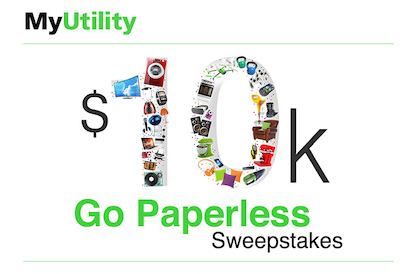
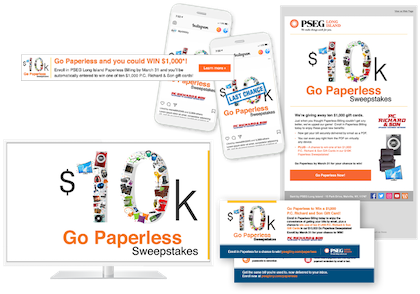
Example of Paperless Billing Incentives ad for sweepstakes

Questline Digital data shows that paperless billing promotional emails with incentives have a 17% higher open rate and 28% higher CTR than messages without incentives. Customers enjoy having the opportunity to earn prizes, especially after learning about the many benefits of paperless billing.

Still, even after identifying the right incentive, it can be daunting to build a campaign strategy that maximizes conversions.

Success starts with a subject line

An incentive-focused paperless billing email begins with an effective subject line that clearly explains the offer. If the giveaway is immediate, let your audience know by using language like “Claim your reward now.”

Follow these subject line best practices for paperless billing incentives:

  • Subject lines that clearly state the incentive reach 13% more of their intended audience compared to subject lines that only imply an offer.
  • Subject lines with “We’ll Pay Your Bill” in the title drive high open rates, but fewer click-throughs.
  • Conversely, subject lines with the word “free” typically do not perform well. This word is often associated with spam.

High-ticket prizes vs. low-cost giveaways

It’s best to test high-ticket and low-cost paperless billing incentives to see what resonates most with your utility’s customers. Consider having a mix of promotions included in your campaign strategy to connect with different customers and vary the giveaways.

Keep in mind that bigger paperless billing incentives do not necessarily mean bigger engagement. While large-dollar-amount prizes drive customer interest in opening promotional emails, that enthusiasm can sometimes be diminished through the contest-entry process.

The “cost” for entering into the drawing is an immediate conversion into paperless billing; this can create an unequal transaction where your customers are asked to give up paper bills for a small chance to win a reward.

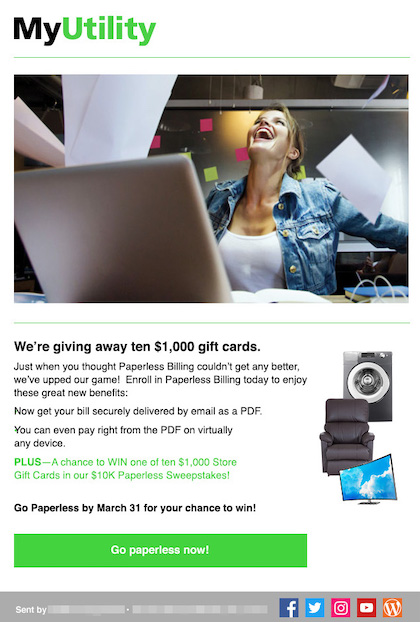
Example of Paperless Billing Incentives with Gift Card Contest

In comparison, we’ve found small incentives are often more effective because they have an immediate, guaranteed payoff. According to Questline Digital data, compared to a contest to win one big prize, small incentives for every customer have a 13% higher open rate and 82% higher CTR.

Based on an analysis of the paperless billing incentives campaigns deployed by Questline Digital, we have found:

  • Awarding a $5 gift card to all signups converts better than enter-to-win contests of $1,000 or more.
  • Products like LED light bulbs rank second among the best drivers of click-throughs.
  • Thermostats and smart home device giveaways are also top performers.
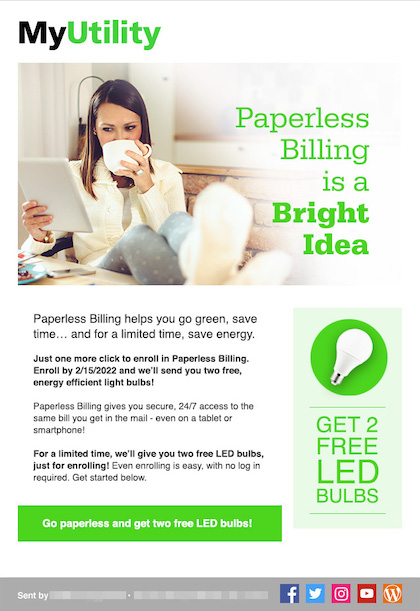
Example of Paperless Billing Incentives with LED giveaway

Make incentives easy to earn

Making the process easy to sign up for paperless billing is key to increasing conversions. In fact, one-click opt-ins into paperless billing programs increase conversion rates by 22%.

It should be equally easy to earn paperless billing incentives. Customers will appreciate a simple, one-click process to enroll in paperless billing, but the immediate question following signup is, “When will I get my prize?”

Make sure your utility is prepared to answer this question in detail. Share next steps with customers, including if you need to receive their mailing address for prize delivery, if they need to print a coupon or any other steps needed to redeem their incentive.

Make this process just as simple as enrolling and your customers will wonder why they didn’t make the switch sooner.

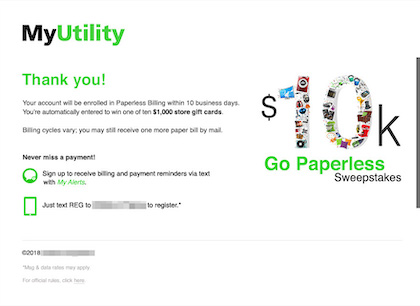
Example of Paperless Billing Incentives sweepstakes entry message
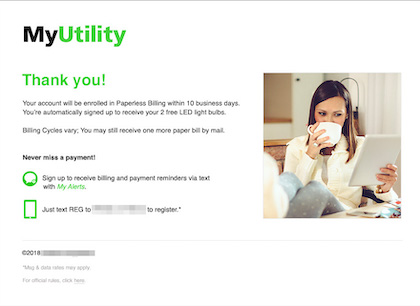
Example of Paperless Billing Incentives thank you message

The power of paperless billing incentives

Everyone likes free things. By offering paperless billing incentives to encourage conversions, customers are more likely to embrace the benefits of eBills.

Paperless billing incentive campaigns are also a great way to encourage re-enrollment from customers who may have unenrolled from past eBill programs. Maybe they unenrolled by accident or didn’t quite understand the benefits. Either way, an incentive-based campaign can be a perfect re-introduction.

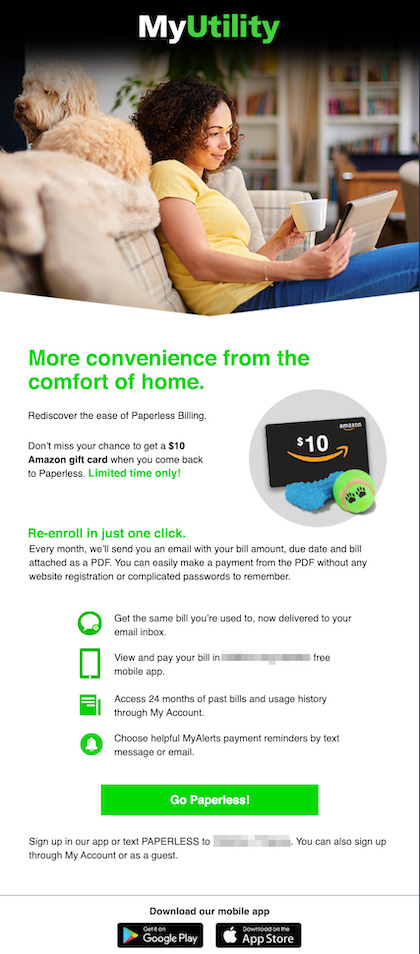
Example of Paperless Billing Incentives with Amazon Gift Card

Incentives provide a massive return on investment for energy utilities, saving operational costs every month for every paperless customer. That’s what we like to call a win-win.

Drive more paperless billing conversions with a digital engagement strategy from Questline Digital.

The benefits of choosing paperless billing may be obvious to you. But your customers may not understand these benefits, or they may not be properly incentivized to give up paper bills and make the switch. Follow these e billing best practices to improve your energy utility’s e bill marketing and boost conversion rates.

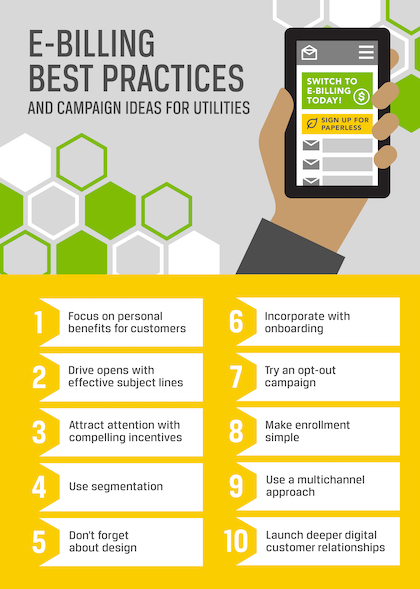
Infographic listing best practices for energy utility paperless billing promotions

E billing best practice #1: Focus on personal benefits for customers

Your messaging should help customers understand the benefits of paperless billing and overcome potential barriers that might stand in the way of adoption. The most successful messages speak directly to the customer, use personal language (“you”) and address the ways that paperless billing makes everyday life easier. Focus on solving problems, not just offering a new payment option.

In Questline Digital’s experience creating paperless conversion campaigns for energy utilities, the benefits that most appeal to customers are: 

  • Simple; easy to manage and pay from anywhere
  • Affordable; no need to buy stamps or worry about late fees
  • Convenient; saves time and fits into your on-the-go lifestyle
  • Eco-friendly; reduce your environmental footprint by using less paper
  • Reliable; never forget or lose track of a bill again
  • Secure; safely manage statements and payments online

E billing best practice #2: Drive opens with effective subject lines

The best email subject lines are upbeat, active and strike a personal tone while encouraging the customer to open the message. Short subject lines are best for capturing the attention of residential customers. Questline Digital data shows that subject lines with 40 to 50 characters perform best.

According to metrics from the many paperless billing campaigns Questline Digital has deployed for energy utilities, the top-performing subject line was, “You’ve got eBill and a $10 gift card.” This campaign achieved a 77% open rate, compared to 21% for the average campaign.

E billing best practice #3: Attract attention with compelling incentives

Incentives pay off in paperless billing campaigns, enticing customers with the promise of a contest prize or financial benefit. Not only do incentives boost email open rates, but incentives also increase conversions.

The most successful incentives are small giveaways awarded to everyone who signs up for paperless billing (including LED lightbulbs and $5 gift cards). Contest entries that award a single large prize (such as $1,000 cash or major league sports tickets) have been less successful.

Offering an incentive pays off with higher conversion rates (and by reaching participation goals more quickly). Paperless billing campaigns that award an incentive achieve a 34% conversion rate on average. In comparison, campaigns with no incentive achieve a 23% conversion rate on average.

Example of e-billing best practice incentive campaign

E billing best practice #4: Use segmentation

The same message or incentive is unlikely to work with all customers. Instead, your utility should segment customers into groups and build campaigns that speak to the specific concerns of each audience.

McKinsey’s Next in Personalization 2021 Report shares that, “71% of consumers expect companies to deliver personalized interactions. And 76% get frustrated when this doesn’t happen.” Furthermore, McKinsey shares that companies that excel at personalization generate 40% more revenue from those activities than those who don’t.

As this data showcases, personalization is a must-do e billing best practice. Here are several ways you can segment your paperless promotion emails:

  • People who pay online but still get paper statements
  • Follow up with those who didn’t complete e bill signup
  • Eco-friendly message to EV customers
  • Convenience message to busy professionals and parents
  • Security message to older audiences or customers with smart security systems
  • Decluttering and convenience message to small business owners

E billing best practice #5: Don’t forget about design

You want the imagery in your e bill promotions to be relatable to customers, eye-catching and relevant. Consider your specific audience demographics and build in visual elements that help customers see themselves in your campaigns.

  • People – age, gender, race, socioeconomic status
  • Region-specific – weather, transportation, landscape, city landmarks
  • Customer interests – sports, culture, the environment, value and motivations

For example, Questline Digital worked with the Pittsburgh electric utility Duquesne Light to alter imagery to represent Steelers and Penguins sports team colors. This small alteration made the email campaign more relatable to the group of recipients.

How you display these images also matters. Consider designing around the inverted triangle strategy, grabbing a customers’ attention at the top, building anticipation in the headline and first few sentences and then taking them to the call-to-action.

To ensure the email is easy for customers to read, there should be plenty of white space throughout the design, clear line breaks and adequate use of bullets or icons.

Example of e-billing best practice email design

E billing best practice #6: Incorporate with onboarding 

It can be difficult to encourage customers to switch their behaviors, even when there are clear benefits or reasons to do so. Humans are creatures of habit and change isn’t easy.

Get customers enrolled in e billing on day one. Share electronic payment options at the start of service so you don’t have to convince customers to change later. Include prompts in onboarding materials and welcome emails, or run e billing campaigns at the beginning of the customer lifecycle.

E billing best practice #7: Try an opt-out campaign

Rather than asking customers to sign up, automatically enroll them in e bill and give them an opportunity to opt-out. If you take this approach, ensure you have adequate communication that keeps customers informed.

For example, Questline Digital ran an opt-out campaign with a Southeast utility. We targeted customers who received both a paper and e bill, but who had made at least one electronic payment in the past. This audience segment was automatically enrolled in the program but given the chance to opt-out and continue receiving paper bills. The opt-out campaign received positive customer feedback, with 90% of customers remaining enrolled. 

E billing best practice #8: Make enrollment simple

Customers abandon complicated digital processes. In fact, a study by Splitit showed that 87% of online shoppers abandon their carts during the checkout if the process is too long or complicated. Signing up for paperless billing is no different – customers want frictionless digital experiences.

Remove as many steps as possible for your customers. One effective way to do this is by auto filling forms with dynamic coding.

Questline Digital worked with PSE&G to set up one-click enrollment, making the sign-up process as easy as possible. Customers who clicked on the call-to-action within an email campaign were automatically taken to a landing page to confirm their information in a prepopulated form and enroll in paperless billing. The ease of one-click signup encouraged customers to make the switch, enrolling 21,945 customers.

E billing best practice #9: Use a multichannel approach 

Unfortunately, you can’t rely on email to convert all your customers. To get the best possible results, your utility will need to employ a multichannel approach and spread out the heavy lifting.

Complement your email campaigns with channels like direct mail, social media, outdoor signage and online advertisements. Your customers may need to see your message multiple times before they act. If you can get in front of customers via multiple mediums, they’re more likely to convert.

E billing best practice #10: Launch deeper digital customer relationships

Paperless billing conversions create an opportunity for long-term engagement by cementing the customer’s digital relationship with their energy provider. Once converted, paperless billing subscribers are more engaged with email communications and less likely to unsubscribe compared to customers who receive paper bills.

Before converting to paperless, energy utility customers have an average email open rate of 25%, according to Questline Digital performance metrics. After converting, paperless billing customers have an average open rate of 33%.

This higher engagement rate is an opportunity to connect with customers beyond their monthly e bill — sharing program promotions, energy efficiency advice and other educational content. By following these e billing best practices and boosting conversion rates, you can reduce operational costs and build long-lasting relationships between your energy utility and its customers.

Convert more customers to paperless billing

Converting customers to e bill doesn’t have to be difficult. Employ these e billing best practices and realize the many benefits of going paperless.

Learn how Questline Digital’s paperless billing solution and help your energy utility reach your e bill conversion goals.