Communicating with customers about products, services and other offerings is vital, and email marketing can be an extremely effective channel for these messages. However, reaching a customer’s inbox is much more complicated than drafting a message and hitting send. That’s where email deliverability comes in.

What is email deliverability? It’s the ability to get emails into customer inboxes — where they belong. But why is email deliverability important? And how is it different from delivery rate?

Delivery rate tells you how many emails weren’t bounced or rejected, while deliverability gives you more insight into exactly where the emails landed — in the inbox, spam folder or places like the promotions or social tabs in Gmail.

Basically, deliverability is crucial to ensuring your messages reach customers and it’s a strong measurement of email campaign performance.

So, how do you ensure a high deliverability rate? The following email deliverability factors will determine if your messages are delivered to customers, sent to the junk folder or blocked altogether.

4 Factors that Affect Email Deliverability

  1. Spam filters
  2. Invalid email addresses
  3. Junk mail reports
  4. Low engagement

1. Spam filters

Once upon a time, in the early days of email, recipients got anything and everything all at once — and it was mostly things they wanted. Then spammers showed up, competing for inbox space and attention. Email recipients needed help, and internet service providers (ISPs) came to the rescue. Working with other gatekeeper ISPs, mailbox providers and anti-spam solution providers, they devised a system to keep those spam messages out.

But this is no fairytale. Although your energy utility is undoubtedly not a scammer, your messages can still be blocked or sent to junk if they don’t get an all-clear from email filtering systems.

Anti-spam filters analyze the entire email — sender to footer — and use a complex scoring system to determine which emails should be classified as spam. All of this happens in real-time, too; your email could be doomed to junk mail before the send is even complete if the filter detects these red flags:

  • Bulk mail sent all at once or at odd hours
  • The sender’s identity is unauthenticated with ISPs
  • Poor reputation or inclusion on third-party blacklists
  • Large email (over 60 KB) with attachments
  • Frequent use of common spam words, like “act now” and “risk-free”
  • Inconsistent branding, sending domains and domains in call-to-action links

2. Invalid email addresses

How often your energy utility sends messages to invalid addresses can also affect your deliverability. Addresses can be labeled as “invalid” in two ways:

  • Emails bounce: Messages will “bounce,” or be rejected by a mail server, if there are typos in the address, the server is unavailable or the recipient has a full mailbox.
  • The address is not currently engaged: If a subscriber hasn’t opened an email from your company in a year — or even a month in some cases — their address will be recognized as disengaged.

Continuing to send to these email addresses can hurt your deliverability, even if other recipients are opening and engaging with your messages.

3. Junk mail reports

Possibly the most obvious red flag to an ISP that your email may be spam is when a recipient marks your message as spam. This can happen if a recipient doesn’t remember subscribing to your communications, doesn’t find the content to be relevant, or wants to unsubscribe from your email list quickly and hassle-free.

Though you can’t stop this entirely, sending additional emails to these recipients can negatively affect future deliverability and how ISPs view your messages.

4. Low engagement

ISPs continue to monitor recipients’ behavior after an email is delivered. They can analyze how long an email is open, if the recipient scrolls through the message, if links are clicked and more.

If your recipients don’t positively engage with your content, ISPs may label you as a sender with low or negative engagement, further harming your reputation and increasing your chances of encountering a spam trap.

How to Improve Email Deliverability Rates

There’s no need to fear. You can improve email deliverability and fix any damage caused in the past with these tips:
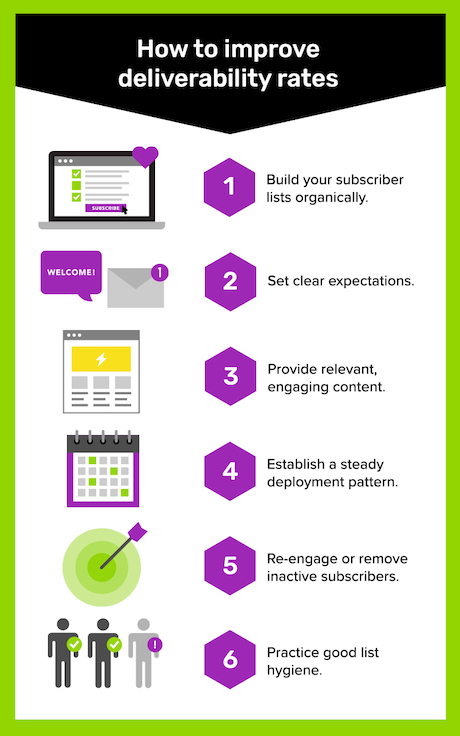
Chart listing the factors that improve email deliverability
  1. Build your subscriber lists organically. Allow customers to opt-in to emails and select which communications they want to receive and how often they get messages.
  2. Set clear expectations. Start your communications with a welcome message that sets the tone for future emails and familiarizes your customers with your services.
  3. Provide relevant, engaging content. Disengaged recipients spell trouble for customer relationships and spam filters alike. Provide great content your subscribers need and keep subject lines brief, informative and engaging.
  4. Establish a steady deployment pattern. As mentioned above, sending too often or erratically can signal to ISPs that you’re up to no good. Setting a regular schedule for email sends establishes consistency with your customers and ISPs.
  5. Re-engage or remove inactive subscribers. A targeted re-engagement campaign can win back disengaged subscribers and clean up your list by removing those who don’t participate or choose to unsubscribe.
  6. Practice good list hygiene. In addition to removing inactive addresses, Questline Digital Project Manager Summer Corson says senders should regularly check email lists for broken or misspelled addresses, delete duplicated recipients and remove addresses that show up as bounces or who have unsubscribed. “This can help boost their deliverability and open rates for their emails,” she says.

Boost Deliverability with Questline Digital

With our email marketing solutions, reaching your customers’ inboxes is easy and stress-free. Questline Digital’s email deployment specialists ensure your communications exhibit the positive email deliverability factors ISPs look for and monitor sends from start to finish.
Leverage Questline Digital’s email deliverability expertise to reach the right customers with the right messages for your energy utility.

Looking to improve digital customer engagement? Behavioral emails could be your answer.

With 75% of emails going unopened on average, your energy utility must work to send customers the emails they want to read. Behavioral sends give customers what they want when they want it.

What Is a Behavioral Email?

Behavioral emails are automated or planned email sends that are triggered by actions taken or not taken by a customer. Instead of interruption or push marketing where brands put messages in front of consumers who may or may not be interested, behavioral targeting builds on pre-determined actions and demonstrated customer interests. This gives customers exactly what they want or need.

Is Behavioral Marketing the Same as Segmentation?

Segmentation refers to building marketing campaigns for specific audiences so you can speak to their unique needs and interests. Segmentation is often done with demographic data or personas. Not all segmentation efforts are classified as behavioral, but all behavioral emails can be considered segmented. Behavioral segmentation is the sorting of people into groups based on actions they take or don’t take.

Why Should You Use Behavioral Emails?

Targeted, personalized messages have the power to transform your energy utility into a trusted partner and resource. Setting up behavior-based email campaigns can help you reach customers when they are ready to engage with you or need your help most.

Data from MailChimp shows that on average, segmented campaigns result in 23% higher open rates and 49% higher click-through rates than unsegmented campaigns.

Questline Digital’s Benchmarks data supports MailChimp’s findings, showing that when energy utilities segment eNewsletters for small businesses they see a vast improvement in customer engagement. Year over year, utilities saw:

  • 11.2% more opens
  • 45.8% improvement in click-to-open rates (CTOR)
  • 62.1% improvement in click-through rates (CTR)

As explained above, behavioral emails take segmentation even further, speaking not only to specific needs and interests, but providing that information exactly when customers need it. Essentially, the right message at the right time.

This is why behavioral emails perform better than promotional marketing emails. According to the Direct Marketing Association, over 75% of email revenue is generated by triggered emails.

Triggers for Behavioral Emails

Actions taken within marketing campaigns are the best triggers for behavioral emails. While actions like signing up for service or making a purchase can trigger automated email sends that are by definition considered behavioral, the largest impact can be made when sending follow-up emails based on clicks or opens.

Triggers for behavioral sends:

  • Open, no click
  • Click but didn’t convert
  • Didn’t open

You can set up automated workflows that follow if/then logic based on the listed actions above. Or if you’re unable to build sophisticated systems, use behavioral lists. Simply remove those contacts that don’t fit the chosen criteria and send targeted follow-up communications.

7 Behavioral Email Examples for Energy Utilities

Energy utilities can take advantage of triggered emails in a variety of ways. Here are seven behavioral email examples to help inspire your customer communications:

1. Welcome series

The most common type of behavioral email is the onboarding message. The action of signing up for service naturally prompts the need for communication. A series of welcome emails establishes a flow of information, helping customers make the most of their new account right away. This can be automated to launch immediately when people sign up for service or be sent every week to new contacts, depending on your email capabilities.

2. Program enrollment

When promoting program or paperless billing enrollment, you can use behavioral emails to further prompt customers who don’t act. If a customer clicks into your paperless billing email but doesn’t enroll, you can send a behavioral email with a different subject line, CTA or hero image. They showed interest but may need different information to take action.

Similarly, if your campaign features a time-sensitive sweepstakes or promotion, a behavioral follow-up with “don’t miss out” or “limited time only” messaging can motivate customers who previously haven’t responded to finally act. 

3. Utility marketplace

Many energy utilities are now utilizing abandoned cart emails that are popular in the retail industry. These emails are automatically triggered when a customer leaves an energy utility’s marketplace without completing a purchase. Abandoned cart emails can tout the benefits of the product not yet purchased or include a modest coupon code to further entice customers to complete their purchase.

Another idea is sending a product recommendation email after a customer makes a purchase to encourage them to shop again. When you know what customers have already purchased, you can predict what they will buy or need next and make helpful recommendations. This is a tactic that Amazon uses, with 35% of its sales directly attributed to making product suggestions based on past behaviors.

Your energy utility can also benefit from following up with useful tips on how to make the most of a recent purchase. A triggered content email that explains how to use a smart thermostat after one is purchased from your marketplace can go a long way in helping customers enjoy their new product.

4. Activity reports

You likely already have this type of behavioral email in place. Each month you may send customers payment confirmation emails or energy usage summary reports. Both are considered behavior sends because they are triggered by actions taken by the customer.

5. Web views

With proper tracking and systems in place, you can see when customers view specific pages or products on your website. If you find that a customer is viewing multiple pieces of content related to renewable energy, you can build an automated email or email series that is triggered to send after a specific number of views. This allows you to automatically send them communications that answer common questions about the topics they are researching.

6. Engagement

Take action on customers who don’t regularly open emails. For example, if a customer doesn’t open their eNewsletter for six months, you can set up an automated re-engagement campaign to encourage them to update their email preferences and subscriptions.

7. Service

When you complete a customer service call, send an automated email that asks for customer feedback. Get feedback in real-time when memories are fresh so you can take appropriate action and keep customers happy. Not to mention, capture the positive service wins of your employees.

7 More Behavioral Email Examples

Triggered emails are used by marketers in all industries, but retailers and ecommerce brands tend to lead the pack. Check out the behavioral email examples below.

1. Abercrombie & Fitch

After a customer viewed loungewear on the Abercrombie & Fitch site, but took no action, the retailer sent a behavioral follow-up that encouraged the shopper to “take another peak.”

2. Section 119

Or this example from Section 119. The retailer followed up on a web visit with the simple question, “Where’d you go?” and offered up related products to encourage more sales, adding a sense of urgency around merchandise availability.

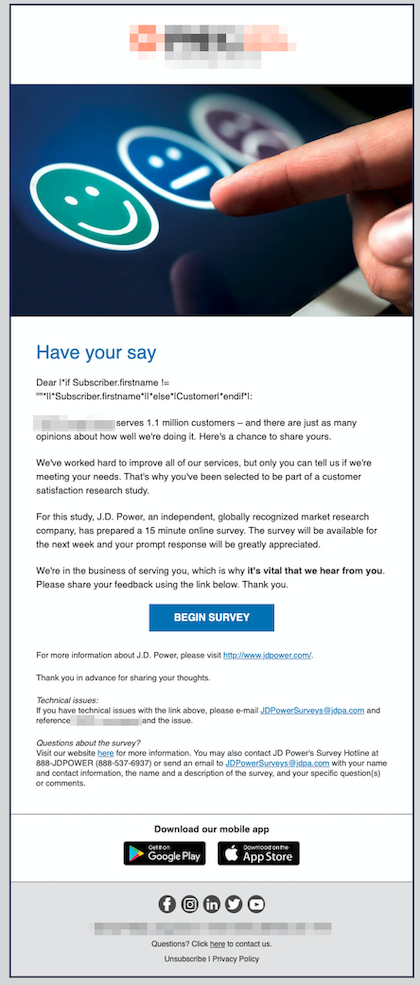
3. Utility customer satisfaction survey

Getting customer feedback is essential. But when sending J.D. Power survey requests, it’s unrealistic to expect one email to garner maximum participation. To increase the likelihood of getting feedback Questline Digital helped one of our clients to set up reminder emails to send to customers who didn’t open or click previous messages.

Behavioral email example of utility sending customer satisfaction survey

4. Questline Digital

Here is a behavioral email example that Questline Digital uses in our own email marketing efforts. When a recipient opens an email about our upcoming webinar but doesn’t register, we trigger another email to send a few days later, encouraging them to finish signing up.

Behavioral email example of Questline webinar promotion

5. Homage

Post-purchase follow-up is a common use for triggered emails. Check this behavioral email example from Homage. After a customer purchased a gift card, they emailed to see how the experience went. They also made suggestions for future purchases and invited the customer to join them on social media.

6. Amazon

Here’s an incredibly simple behavioral email example from Amazon. Users with a wedding registry receive a promo code one week after their wedding date. Fully automated, this email prompts additional sales at the exact moment the newly married couple has extra cash in hand from wedding gifts.

7. Grist

Welcome emails classify as behavioral sends. Post signing up for an eNewsletter with Grist, subscribers receive the following email with information on what to expect next and how to update their preferences.

Getting Started with Behavioral Emails

Could your energy utility’s program promotions benefit from the addition of behavioral emails? If you’re not doing them already, the answer is yes. Building automated email sends and/or setting up manual workflows based on customer actions is one of the best ways to boost email engagement and program participation.

Learn how Questline Digital can elevate your digital customer relationships with behavioral email marketing.

When severe weather threatens, your energy utility may need to send power outage notification emails to customers. To level-set customer expectations and ensure long-term customer satisfaction, your outage communications strategy shouldn’t wait until an outage happens.

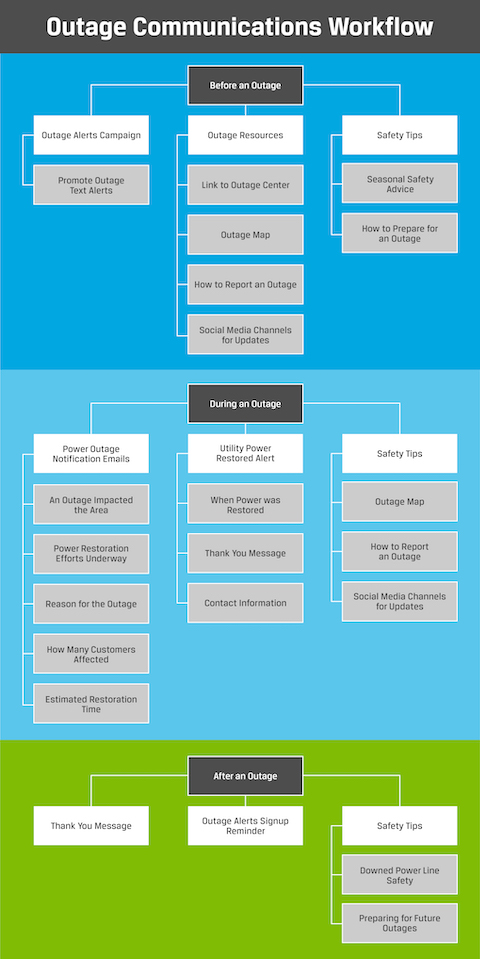
Optimize your outage strategy with an outage communication template that includes useful information and resources customers will need before, during and after a severe weather event.

Chart showing outage communications workflow and listing email messages a utility should send before during and after an outage

A Surge in Severe Weather

In recent years, extreme weather has become more common across the U.S. According to the National Centers for Environmental Information, the U.S. averaged 17.2 severe weather events per year from 2017 to 2021, including flooding, severe storms and wildfires. In comparison, between 1980 and 2017, there was only an average of 7.4 severe weather events per year.

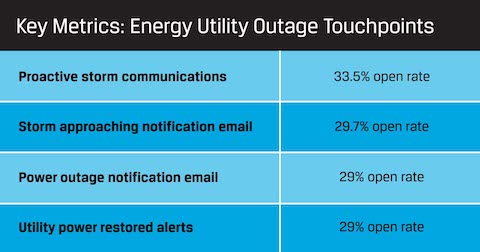
This trend can be seen in the growing popularity of power outage notification emails sent by energy utilities from coast to coast. According to Questline Digital’s Energy Utility Benchmarks Report, customers are highly engaged with outage communications, with a 27.1% open rate for residential customers and a 36.6% open rate for business customers.

Outage messages are consistently among the highest open rates of all utility email categories:

Chart showing performance metrics of outage communications template

Energy utility customers value storm and outage-related messages. As storm intensity continues to grow, an effective and customer-centric outage communications template will become even more vital for energy utilities.

Power Outage Communication Template: Before the Storm

While you can’t stop severe weather, you can help your customers prepare for it. An effective outage communication template should include an introduction to your energy utility’s outage resources, seasonal safety tips and other useful information.

This is the perfect time to educate customers about your energy utility’s outage resources and services, such as where to go to find the latest outage information or how to report an outage.

3 key topics for pre-storm communications

  1. Outage alert opt-ins: Encourage your customers to sign up for outage alerts with a proactive, omni-channel preparation campaign.
  2. Outage resources: Educate customers about your energy utility’s online resources, directing them to your outage center or outage resource page.
  3. Seasonal safety tips: Share summer and winter storm safety tips, as well as how to prepare for a power outage.

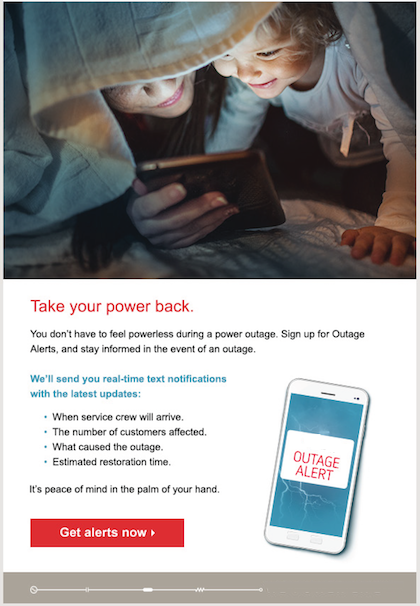
With the help of Questline Digital, a Southeast energy utility created a powerful creative campaign as part of their outage communication template. The goal was to inspire customers to receive text alerts and not feel powerless during an outage.

The campaign targeted customers who were not already signed up for text alerts with messaging focused on the benefits of real-time notifications like utility power restored alerts.

Example of outage communications email to improve utility customer satisfaction

Power Outage Communication Template: During the Storm

When an outage happens, urgency and transparency are key. It’s important to share updates as quickly as possible with customers across multiple channels, including power outage notification emails, text alerts and social media.

During an outage, customers appreciate acknowledgement of the situation from their energy utility, along with ongoing updates to keep them informed. Energy utilities can educate customers on the important steps involved in restoration, from assessing the damage to addressing emergency situations. This gives customers a better understanding of what it takes to restore power.

Build trust with transparent outage updates

Your outage communication template should include the following information during an outage event:

  • Storms are coming: Inform customers that severe weather is expected and could lead to outages. Don’t forget to provide storm and outage safety tips.
  • Outages have impacted the area: Provide as much detail as possible to affected customers in a power outage notification email, including the extent of the outage and number of customers impacted.
  • Power restoration efforts are underway: Communicate regularly on restoration efforts and when customers can expect power to be restored.
  • Reason for the outage: Transparency is key. If the cause is determined, share this additional information with customers.
  • Power has been restored: Thank customers for their patience with a utility power restored alert. Be sure to include contact information in case they are still experiencing issues with their electricity.

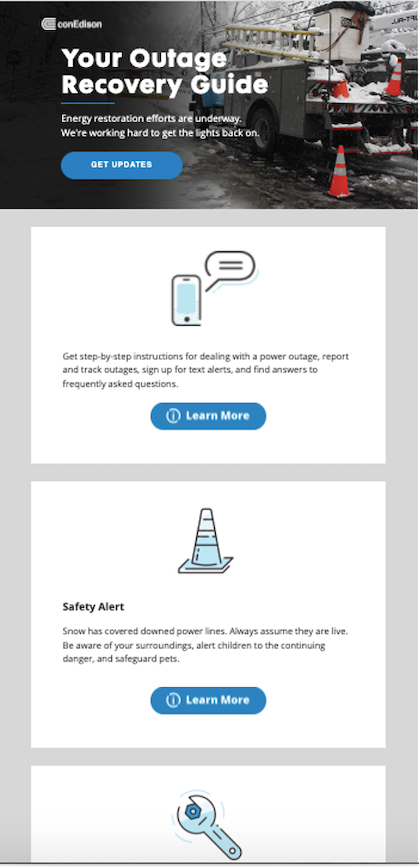
Whether storm prep or outage resources, there is no one-size-fits-all for your outage communication template. In this sample outage notification from Con Edison, the energy utility provides customers with an “Outage Recovery Guide” in the midst of an outage:

Sample of outage notification email from energy utility

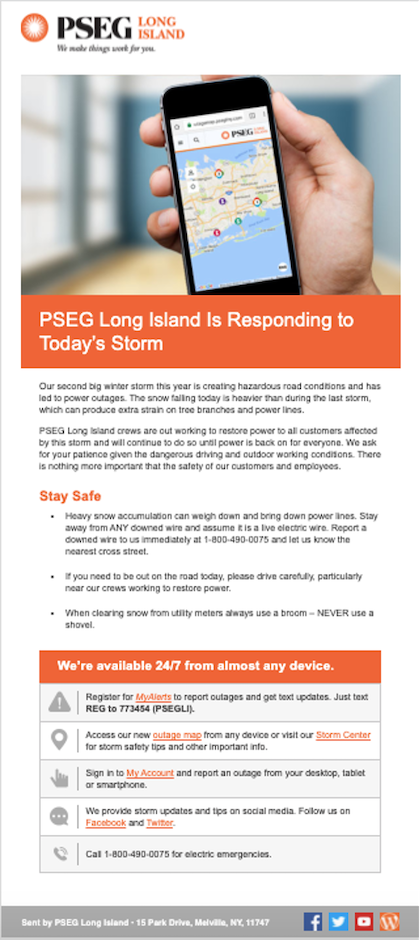
A sample outage notification from PSEG Long Island is a great example of transparent communications. The email explains the reason for the outage — in this case, a major snowstorm. The energy utility then acknowledges that power restoration may take time due to the dangerous driving and outdoor working conditions.

Sample of outage notification email with restoration information

Power Outage Communication Template: After the Storm

After an outage event, your energy utility should reevaluate your communication strategy to see what is and isn’t working. Keep these questions in mind:

  • What channels are best to communicate outage information?
  • How many power outage notification emails should our energy utility send?
  • When should outage updates be sent?
  • Are we communicating enough information to customers?

Your outage communication template should include a follow-up email a couple days or weeks after an outage. This is a great opportunity to encourage your customers to sign up for outage text alerts, ensuring they are prepared for future outages. With the outage still top of mind, this email creates a compelling motivator for customers to sign up for alerts.

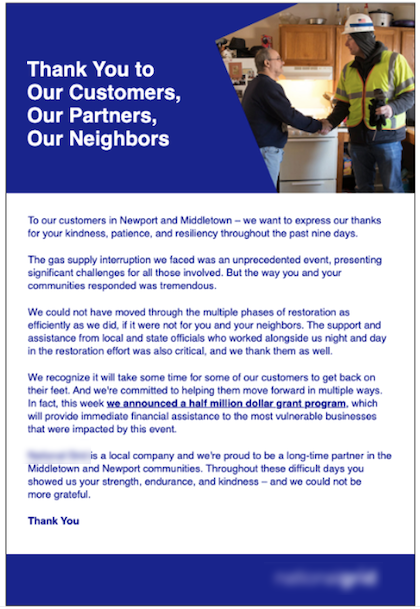
A large IOU in the Northeast sent a thank-you email to customers for their “kindness, patients and resiliency” after a gas supply interruption that presented significant challenges:

Example of power outage notification email

Get Ready for Severe Weather with an Outage Action Plan

Effective outage communications requires much more than a simple power outage notification email. Be proactive with outage communications to ensure customer safety, encourage engagement and increase customer signups for outage-related programs.

The right outage communication template can help your customers find peace of mind when the power goes out — and help your energy utility achieve long-term customer satisfaction.

Provide essential information before, during and after severe weather with an outage communications strategy from Questline Digital.

Don’t sleep on welcome emails. They are one of the most effective forms of marketing automation you can set up. Here are a few reasons why…

  • The average open rate for welcome emails is 60.3%, which makes them 114% more attention-grabbing than standard emails.
  • Compared to regular email marketing, welcome emails make 320% more revenue on average.

When a customer signs up for service, they subconsciously seek acknowledgment. They want you to greet them upon their arrival. Remember the saying, “Great hosts greet their guests” and apply the mentality to your emails.

But alas, no one will open your message unless your subject line inspires them to. Here’s how to craft a compelling welcome email subject line that encourages opens.

3 Rules for Writing Great Welcome Series Subject Lines

Don’t overthink your welcome email subject lines. Straight-forward messages perform best. Follow these basic rules and you’re sure to catch attention.

  1. Use a simple hello, hi or howdy. Make it obvious what your message is all about. Your customers just signed up for utility services and are expecting to receive onboarding information. Make them feel welcomed.
  2. Offer a discount or immediate value. Give customers a specific reason to open your email. Include rebates, incentives or other benefits that customers can take advantage of right away. Make your value apparent.
  3. Suggest next steps. Include instructions, a CTA or action verbs to spell out what you want customers to do with the information you’re sending. Make it so they can’t miss the important stuff (like billing).

Best Performing Welcome Email Subject Lines

Check out the top-performing welcome series subject lines, pulled from Questline Digital’s industry-wide marketing performance data. Each example follows the tips outlined above and successfully compels customers to act.

Subject LineOpen Rate
Explore your billing and payment options94.7%
The power is in your hands94.1%
Welcome to [Utility Name]94.0%
[Utility Name] is here to help you93.3%
Billing and payment options – made easy91.7%
Convenient billing options for your business90.1%
Welcome to the [Utility Name] family!87.9%
Let us help you manage your energy costs85.7%
Account and billing options you need to know85.3%
3 outage resources you need to know about84.2%

What to Include in Your Welcome Series

An effective welcome series includes three to five emails. That’s why you’ll need multiple welcome email subject lines within your onboarding series. Lucky for you, that means you can test which topics and words garner the most attention.

Whichever way you choose to organize your welcome information, common topics include:

  • My Account set up
  • Billing options
  • Available discounts or rebates
  • Outage resources
  • Community involvement
  • Energy efficiency resources

Don’t make it overly complicated! Provide your customers with what they need and make it obvious what you’re offering or asking them to do. Remember, new customers want to hear from you. An effective welcome series should be the start of long-lasting — and highly satisfied — digital relationship with customers.

Learn more about Questline Digital’s proven solutions to build digital engagement with new utility customers.

No matter the brand, first impressions with new customers are everything. That’s why a great welcome message is essential in every industry, from retail to hospitality and everything in between. For the energy utility industry, an effective welcome email design has the power to increase customer engagement, drive program promotion conversions and build long-lasting satisfaction.

According to Questline Digital’s 2022 Energy Utility Benchmarks Report, 60.2% of Welcome Series emails were opened by customers in the past year — the highest engagement rate in Benchmarks history. Welcome Series also experienced a high CTR of 11.9%. A great welcome message sets the stage for successful digital customer relationships and provides a valuable introduction to your energy utility.

Welcome Email Design Best Practices

Welcome emails are the first digital interactions customers have with your energy utility. Typically, these communications are saved by customers and make a great point of reference. Your welcome email design should give customers exactly what they want and need. Set the precedent for the value they will receive by opening and reading the email.

“This is the introduction of your energy utility — that’s why it’s vital to think long-term,” says Joe Pifher, Questline Digital’s Creative Director. “Keep your branding as evergreen as possible. Once you have a good formula for the content in your Welcome Series, there’s really no reason to change it.”

According to Pifher, a great welcome message should incorporate these best practices:

  • Include more detailed information than a standard email.
  • Divide topics into sections for easy reading.
  • Use icons to help customers find topics at a glance.
  • Stay as true to your utility’s brand as possible.

“As with any communication, keep your email clean and easy to read,” Pifher explains. “Bucket topics together so they are easy to find when customers are skimming the content. I also suggest using icons to help with a quick search.”

Pifher also recommends these basic principles for welcome email design:

Think about accessibility: To ensure ADA compliance, add alt tags to all images. In addition to tagging, use a Web Content Accessibility Guidelines (WCAG) checker to make sure fonts and color contrast are readable for vision-impaired customers.

Use live text: If your hero image includes a headline, live text makes this copy visible if a customer has their “images” turned off. With live text, these customers aren’t missing important information.

Be mobile-ready: Mobile-optimized welcome email design is essential today. In fact, more than 63% of residential customers read emails from their energy utility on smartphones.

Be aware of dark mode: Many customers prefer dark mode, which helps reduce visual strain. Multiple surveys show that over 80% of consumers use dark mode on one or more applications.

To give your energy utility some inspiration, check out these welcome email samples for new customers from a wide variety of industries.

Welcome Email Design #1: Thrive Market

Thrive Market, an e-commerce retailer offering natural and organic food, begins its welcome email with a short letter from the co-founder and CEO. The letter speaks to the brand’s focus on health and sustainable living, which resonates with its target audience of eco-friendly consumers.

The welcome email design provides customers with a quick snapshot of resources to begin their journey with the e-commerce site, including an FAQ section, helpful health tips and recipes, and how to shop their exclusive products. Thrive Market also highlights their company’s efforts to make a positive impact on the planet, such as becoming a 100% carbon-neutral company.

Takeaway for energy utilities: Based on this welcome email sample for new customers, the first email in your Welcome Series is a good spot for a short letter from your energy utility’s president. In your welcome email design, you could also include a message from a lineworker, giving the email a neighborly feel. Similar to Thrive Market’s approach, consider sharing helpful energy efficiency tips and promote your marketplace.

Welcome Email Design #2: Airbnb

Airbnb’s welcome message makes it easy for new customers to understand how the vacation rental company’s service works while providing imagery of enticing destinations and travel inspiration.

This great welcome message outlines what a customer can expect when booking a stay with Airbnb, including host verification, secure payments and cancellation policies. It also provides links where customers can learn more about the company and visit the Help Center.

Takeaway for energy utilities: Incorporate Airbnb’s educational approach into your welcome email design by providing customers with clear and easy-to-understand information about your energy utility’s programs and services.

Make it as easy as possible for your customers to enroll in My Account, paperless billing, outage text alerts and other essential services. Also, be open about what customers can expect from your energy utility, such as transparency and quick response during outages.

Welcome Email Design #3: Apple TV+

Apple sends out a welcome message to new Apple TV+ subscribers. This welcome email sample for new customers provides a brief overview of the streaming service and shares popular movies and series to encourage subscribers to start streaming. The email also promotes the Apple TV app, which makes it easy for subscribers to watch their favorite shows from any mobile device. The simple welcome email design features concise messaging, which resonates with today’s on-the-go consumers.

Takeaway for energy utilities: Energy utilities benefit from a clean welcome email design and straightforward messaging. Copy should be short and sweet while providing customers with a relevant overview of your energy utility. Instead of including too much copy in one email, provide a short description and link to your website for more information.

We see success with an average of four emails per Welcome Series campaign. This approach allows your energy utility to deliver information in smaller, targeted pieces over time, rather than one overly long email. Like Apple, your energy utility also has the ability to share recommendations, such as popular products from your energy utility’s marketplace.

Welcome Email Design #4: Lush Fresh Handmade Cosmetics

In this welcome email sample for new customers, the beauty retailer Lush shares product recommendations, encouraging customers to shop online. The welcome message also explains how customers can interact with the brand through product tips and behind-the-scenes videos on social media. The welcome email design utilizes vibrant, colorful images that showcase the brand’s fun personality.

Takeaway for energy utilities: Energy utilities might not have as bold of an image as a beauty retailer like Lush, but that doesn’t mean you should shy away from showing off your brand personality. For a great welcome message, consider sharing what makes your energy utility a cornerstone of the community, such as philanthropic efforts, employee volunteerism and other involvement.

To capture attention in your welcome email design, take advantage of eye-catching imagery, such as photography of people that reflect your service area’s demographics. Your energy utility could also incorporate actual photos of your lineworkers restoring power or employees volunteering in the community.

Welcome Email Design #5: The Glenlivet

The Glenlivet, a Scotch whisky distillery, takes a personalized approach to its welcome message. The eye-catching welcome email design is casual and conversational in tone, with the bold headline, “Hey There, Whisky Lover.” Perhaps most unique, customers have the opportunity to “create their own adventure” by choosing how they take their whisky. This fun quiz-style email directs them to an alcoholic beverage that is best suited to them.

Takeaway for energy utilities: Energy utilities can increase engagement in their Welcome Series by personalizing the content to residential or business customers. You can further customize your welcome email design with segmented content for new customers and existing customers who recently moved within your service area.

When promoting energy efficiency programs, consider two different messages for homeowners and renters. These audiences have distinct needs when it comes to energy efficiency. For example, homeowners are more likely to make bigger investments, such as installing ENERGY STAR appliances and taking advantage of whole-house energy assessments. In comparison, renters are inclined to make smaller improvements like smart plugs, water-saving showerheads and LED light bulbs.

Look to These Welcome Email Samples for New Customers

A great welcome message gives your customers a glimpse into your energy utility — what programs and services they need to know about, as well as what makes your company an integral part of the community. As you can see in the above examples, the sky is the limit when it comes to saying “hello” to new and moving customers. What matters is finding a way to connect through creativity, personalization, concise messaging and clean welcome email design.

Build strong customer relationships from day one with a Welcome Series from Questline Digital.