An engaged customer is easy to recognize in many industries. In the retail industry, an engaged customer is an avid online shopper who tags their favorite brand on social media. In the spa or beauty salon industry, an engaged customer will book appointments regularly and leave positive reviews on Yelp.

In the energy industry, however, it can be more challenging to define what utility customer engagement looks like.

Customer engagement is the relationship a customer has with a brand. It can be strengthened — or diminished — with every interaction.

Check out the following signs that your utility customer engagement efforts are succeeding.

What Is An Engaged Energy Utility Customer?

An engaged energy utility customer will:

  • Regularly log into MyAccount
  • Sign up for mobile alerts
  • Open and click your emails
  • Connect with your energy utility on social media
  • Take advantage of your programs and services
  • Make repeat visits to your online marketplace
  • Share experiences about your energy utility

Regularly log into their MyAccount or mobile app

If your customers are putting self-serve tools to use, that’s a strong indication they are engaged. If they are logging into their MyAccount or mobile app to pay their bills, look at past energy usage, read efficiency content or choose alternative rate plans, you can be confident that they are paying attention.

Customers who don’t regularly log in can be labeled as “absentminded power users.” They are on autopilot and don’t think much about their utility, the services provided or how they can take control of their own energy usage or spending.

Sign up for mobile alerts

Customers who have signed up for mobile alerts are more engaged than customers who haven’t. These customers are telling you they want to receive the updates you have to share. Whether it’s energy usage alerts, outage updates or general community messages, these customers have indicated they care about what your utility is doing.

Boost engagement quickly by running an opt-in campaign. See how this Southeast utility used email to update more than 275,000 customer accounts for mobile outage communications.
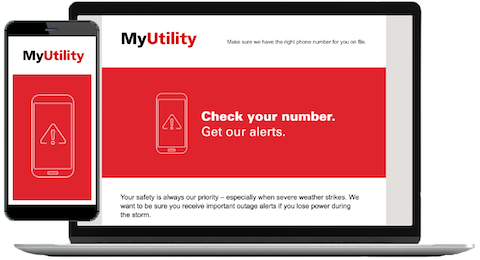
Example of mobile communications to achieve utility customer engagement

Open and click your emails

Utility customer engagement can be easily tracked by looking at email performance. If your customers repeatedly read the content you send them, they are highly engaged.

If customers aren’t opening or clicking your emails, your utility has some work to do. Your emails may not be speaking to specific customer interests. Can you employ segmentation to become more relevant?

Check out the performance metrics for a municipal utility’s monthly residential newsletter. These high open and click rates indicate an engaged readership and customers who see value in their utility.
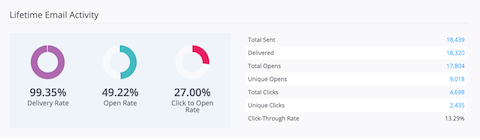
Example of performance metrics showing utility customer engagement

Connect with your energy utility on social media

Your social media platforms are a great barometer for utility customer engagement. Think about your favorite brand — you are more likely to engage with their posts compared to a company you feel lukewarm about.

Engaged customers will frequently like, share and comment on your social media posts because they trust and respect your energy utility. They will also contribute suggestions, requests and ideas on your social platforms, showcasing their loyalty and involvement. They may even leave questions on your social media posts, further showing that they want to engage with you.

Keep in mind, your energy utility needs to have a social media presence with entertaining and educational content for these interactions to take place. If you have nothing worth “liking” to post, how will your engaged customers connect with you?

Whether you share educational videos or fun infographics with valuable insights on energy topics, give your engaged customers a reason to connect with your energy utility on social media.
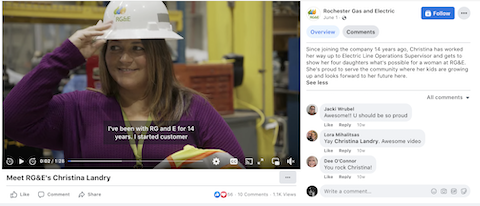
Example of utility customer engagement on social media

See how Rochester Gas and Electric fostered strong customer engagement with its social media content. By highlighting an accomplished employee, the utility gave its community something to celebrate, leading to a high number of comments, likes and views.

Take advantage of your programs and services

Engaged customers will utilize your energy utility’s programs and services to improve their daily lives. This is especially true with MyAccount and paperless billing customers who are more likely to have a strong digital relationship with your energy utility.

Customers attuned to your brand might participate in an energy efficiency assessment or regularly visit your website to find helpful information on topics like renewable energy or home energy savings.

Engaged customers are eager to learn more about programs and services that are relevant to their unique needs and interests. By personalizing content in promotions and newsletters, you’ll increase utility customer engagement over time. Customers will begin to see you as an energy expert and helpful resource in their day-to-day lives.

Make repeat visits to your online marketplace

Customers engaged with your energy utility will make repeat visits to your online marketplace. Research finds that fully engaged customers are not as price sensitive as their unengaged counterparts. Of course, they will look at the price tag, but that is not the only deciding factor. They shop more often, buy more products and are eager to tell their friends and family about your brand.

To encourage customers to visit your online marketplace, try sending regular promotional emails with energy-efficient products of interest to them. For example:

  • For renters, share low-cost products like smart power strips or energy-saving showerheads.
  • For homeowners, share products that require a bigger investment like ENERGY STAR® appliances.
  • For customers who visit your marketplace, consider sending abandoned cart emails when they leave the site without finalizing a purchase.
  • For customers who are previous shoppers, share product recommendation emails to encourage them to make another purchase, such as a smart home hub that’s compatible with the thermostat they bought.

Share experiences about your energy utility

Engaged customers are excited to share their positive experiences, whether it was how your energy utility handled a power outage or the considerable savings from an incentive. These happy customers are eager to share their experiences online through a thread on Reddit, Nextdoor, a Facebook group or official review channels and satisfaction surveys.

While seemingly counterintuitive, engaged utility customers will also occasionally share negative experiences online. Though this may not seem like a good thing, it shows these customers care and are interested in your energy utility and its services. In comparison, unengaged customers will be disinterested, resulting in silence rather than a chance for rectification.
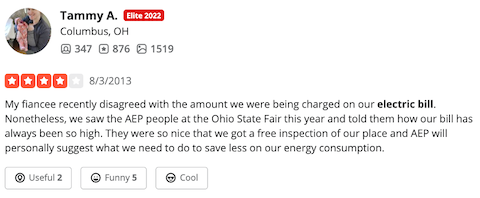
Example of utility customer engagement in online review

See how an AEP Ohio customer was at first dissatisfied by their electric bill, but by speaking up was able to learn more about available services. This review can help educate other customers who may have the same concern.

Boost Utility Customer Engagement with Every Interaction

Every touchpoint can either positively or negatively affect utility customer engagement. That’s why your customer interactions need to provide value, whether you’re sharing educational energy topics in a monthly newsletter or promoting a relevant program to a specific segment of your audience.

With these types of digital customer touchpoints in place, your energy utility can then define what an engaged customer means for your energy utility.

What does an engaged customer look like for your energy utility? Learn how to build stronger digital relationships with an engagement strategy from Questline Digital.

Customer testimonials are a powerful tool to increase credibility and loyalty. In an age where product reviews on Amazon or Target are paramount for driving sales, it only makes sense that customer reviews could do the same for your energy utility.
Customer testimonial videos are impactful for a number of reasons, including:

  • First-hand accounts from customers are more natural and trustworthy than staged videos.
  • Testimonial videos let customers speak about benefits and experiences in a way that appeals to other consumers.
  • Video testimonials help customers easily understand how a program works.

A customer testimonial video allows customers to learn from another person’s experience that they can relate to. Read on to discover more about the value these videos could bring to your utility’s customer engagement strategy.

What Is a Customer Testimonial Video?

A customer testimonial video includes a first-hand review from a customer about a product, program or service. In these videos, a customer will discuss the program or service, their experience with it and their overall views.

Using testimonial videos is a great way to leverage positive consumer experiences to help convert potential customers.

“The value of testimonial videos is to provide real-life, real-world examples of programs or incentives that have worked for other people,” explains Jason Meeker, Questline Digital’s Director of Video Production.

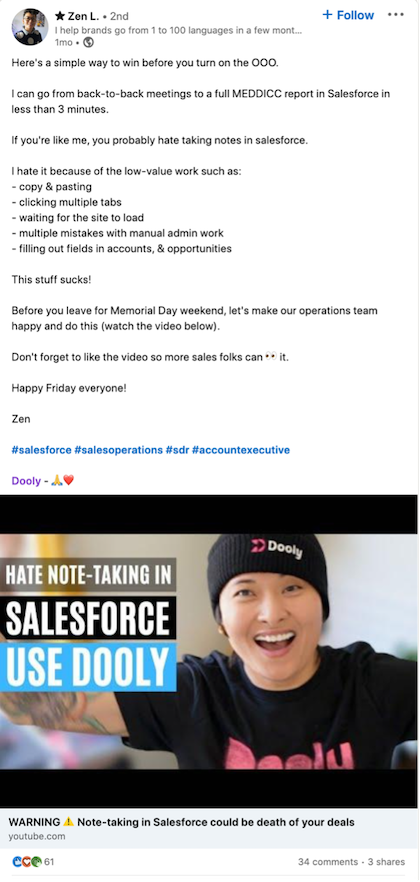
Customer testimonial videos are nothing new. Dive into YouTube and you can find a myriad of “unboxing videos” from YouTubers sharing their opinions that endorse (or not) a brand’s product. These videos don’t even have to be about a tangible product, they could be about software, like this example:

Example of customer testimonial video used in email

Videos like this are popular because people like to learn about products from others rather than blatantly being sold to by a brand. In fact, research from Forrester says that 32% of online consumers trust a stranger’s opinion more than brand advertisements or marketing collateral.

This alone should be reason enough for your utility to invest in customer testimonial videos. Why put money and effort into other materials that your customers don’t want to see?

Why Does Your Utility Need Customer Testimonial Videos?

A customer testimonial video is an advantageous way to sell to and win new customers.

Whether you’re promoting your utility’s products, programs or services to residential or business customers, audiences find value in learning from peers and other satisfied consumers. Nine out of 10 people say that they trust what a customer says about a business more than what that business says about itself.

Additionally, a customer testimonial video gives potential customers the information they need to make a purchase decision. The beauty of a customer testimonial video is that it can be used at the top of the sales funnel to increase awareness in your utility’s program, or it can be used near the bottom of the funnel to convert leads into sales.

First-hand accounts from customers are more natural and trustworthy

People trust people. It’s as simple as that. According to research, 90% of consumers are more likely to trust brand recommendations from other customers, even if they’re strangers.

Sharing testimonials from actual customers who have used your products or programs helps build trust and highlight the user benefits.

It’s important to let these customers speak naturally, so they sound like they’re talking to a friend or family member — not reading from a script. The greatest strength of a customer testimonial video is this relatable language.

Some questions you can ask customers to get the ball rolling include:

  • What was your main concern before buying this product or program?
  • What challenges were you trying to overcome with the purchase?
  • What specific feature do you like the most?
  • How have your day-to-day activities been impacted?
  • Would you recommend this product or program?

Meeker encourages asking prompts that dig into a customer’s experience.

“There are always those questions that can get people talking,” he says. “Try to think of more probing questions that really get to the ‘why’ or the feelings behind it. For example, ask, ‘What are some of the things you wish you had known before you started with the program that you’d recommend people think about before signing up?’”

Testimonial videos share benefits in a way that appeals to other consumers

Would you rather learn about the pros and cons of a new smart home device from your tech-loving friend or have a salesperson hound you to purchase?

The choice is easy. And it’s the same way for your customers.

For business customers in particular, testimonial videos can often balance the technical details these consumers want to know about with the real-life use cases that they’re also interested in.

“For the most part, the business side is going to lean more toward, ‘How does this impact my bottom line and make or save me money?’” says Meeker. “At the residential level, it’s more of an even split between a personal value or belief of wanting to do something as opposed to strictly how it’s going to save money on utility bills.”

The Smart Energy Consumer Collaborative shared that consumers are more likely to adopt energy-efficient technology or programs if their neighbor has adopted them. Likewise, if your utility’s program is focused on reducing demand on the grid, research shows that people use less energy when they think their neighbors care about the environment.

This is all to say that customers are more likely to take action if another customer with a similar situation recommends a solution.

Video testimonials help customers understand how a program works

Testimonials in any form can be useful, but the impact of a customer testimonial video far outweigh the benefits of written or audio content.

For one, customers may question the authenticity of written or audio testimonials. Video testimonials are much more authentic. They feature real people who are willing to associate their name and face with your utility’s program or service.

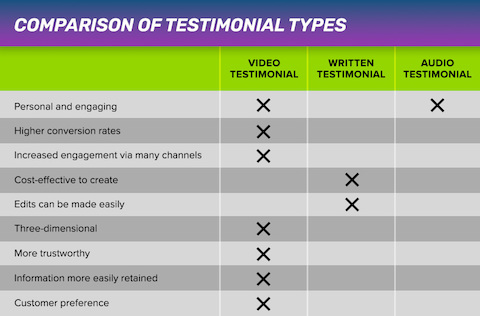
Additionally, video testimonials are typically more personal and engaging, produce higher conversion rates and can be shared on various channels for distribution.

“The benefit of testimonials being on video is that it puts a name, face and personality behind the story,” Meeker explains. “It becomes much more personal. You can actually see and hear the person who has experienced the benefit of the program.”

According to research, 73% of customers prefer to watch a video to learn about a product or service, while 47% of people say testimonial videos are effective because they help visualize how a product or service actually works.

Video testimonials also allow your utility to demonstrate a product or program in action while the customer speaks about it.

“The use of cutaway shots — close-ups of a facility or retail store or apartment complex — gives a visual reinforcement and what you’re hearing that you don’t get with audio or written testimonials,” says Meeker. “It’s a much more visual and immersive experience.”

Chart listing the differences between customer testimonial types such as video testimonial and written testimonial

Where to Share Customer Testimonial Videos

Customer testimonial videos should be shared on multiple distribution channels, including:

Product or program landing pages

Place testimonial videos where interested customers will most likely visit, like the program page. This allows customers to learn about the product or program and immediately be able to watch firsthand reviews.

Using these videos on landing pages can significantly boost conversions because it’s showing proof that your product or program works. Research shows that including videos on landing pages can increase conversions by 86%.

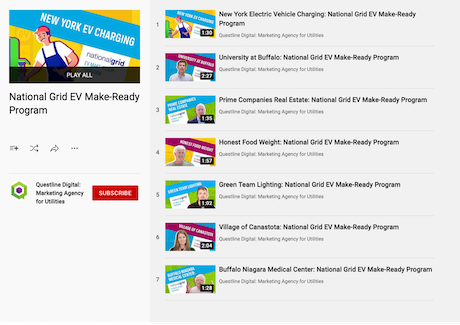
National Grid has a landing page dedicated to their Upstate New York Electric Vehicle Charging Station Make-Ready Program.

Here, customers can learn more about the program and watch customer testimonial videos related to EV charging locations. These locations are separated into categories so customers can view the testimonial video most similar to their situation, like workplace stations, multiunit building stations, retail stores or public destinations.

Video testimonials were chosen to help viewers connect with the program on a personal level. “We tried really hard to put customers in an environment that showed what they were talking about,” says Meeker.

Questline Digital worked with National Grid to create each of these individual testimonial videos, as well as an animated explainer video, to create a well-rounded customer outreach campaign.

“One of the things that stuck to me in this interview series as a whole is the diversity of interview subjects,” says Meeker. “We had a university, medical center, municipality, private business, even a contractor that did the installation of charging stations. They all had different and unique perspectives to share.”

All of the customer testimonial videos can be viewed here.

Examples of customer testimonial videos on YouTube

Social media

Different customers prefer different using digital channels to learn about new products or services. Offering customer testimonial videos on social media is imperative to extend the reach of your campaign.

Videos perform exceedingly well on social media platforms. In fact, Questline Digital’s data shows that videos shared on Facebook attract 200% more engagement than static content.

Create “scroll-stopping” content by creating short snippets of customer testimonial videos for social media users to watch. If they want to hear more from the testimonial, link to the full video on your utility’s website or YouTube channel.

Make sure all videos include captions, as many people prefer to watch videos without audio on social media.

Emails

Some studies show that including the word “video” in email subject lines has the potential to increase open rates by 19%. Additionally, including videos in emails can boost click-through rates by 65%.

Your utility should already be deploying email campaigns to engage with customers, so adding customer testimonial videos to the mix is an easy addition.

Sending these real-life recommendations will have a stronger impact on customers than just having your utility talk about its benefits. An email campaign including a customer testimonial video could be a turning point for sales. In fact, 77% of people who have watched a customer testimonial video say it played a part in convincing them to buy a brand’s product or service.

It’s important to remember that videos can’t be solely embedded into emails. Rather, make it clear that there is a video to watch with a large “play” button overlayed in the hero image or a specific CTA to click through and watch the video.

Events

Now that in-person events are returning, nothing is stopping your utility from including customer testimonial videos in your event or booth set-ups. In fact, hosting in-person events and inviting customers who have had positive experiences with your utility can be some of the best advertising.

“Identifying customers that are good advocates for your utility company is very important,” says Meeker. “For example, National Grid did a really good job at picking interview subjects that were not only pleased with the results but wanted to share their story. This is just as important as the success of the program itself — finding someone who is willing and able to talk about the success in a way that comes across well on camera.”

At the 2022 SECC Consumer Symposium, Dave McKee from JEA shared that their utility hosted in-person events for customers to learn about purchasing and owning electric vehicles. Real EV owners were in attendance to share their experiences with interested individuals.

McKee said, “Electric vehicle owners are so excited to talk about their EVs and share their own experiences that they make for the best salespeople.” This event alone led to two customers purchasing EVs on the spot.

Customer testimonial videos should be integrated with your utility’s broader marketing strategies. They work in tandem with other tactics to push the campaign’s reach and connect with customers in their preferred way.

Harness the Power of Customer Testimonials

Customer testimonial videos are influential because they feature real people talking about real challenges that your utility helped solve. They are persuasive because they’re personable and insightful. Customer testimonial videos provide:

  • An honest way for potential customers to connect with existing customers
  • A dimensional way to show how your utility’s product, program or service works
  • A tool to move customers through the sales funnel

Including customer testimonial videos in your utility’s program promotions is a surefire way to build trust and increase conversions.

Learn how a video content strategy from Questline Digital can put the power of customer testimonials to work for you.

Sending a warm welcome message to customers goes a long way in establishing rapport and familiarizing your audience with your utility’s offerings. An effective welcome email tees up your audience for more inbox communications and lays the foundation for a positive customer experience.

When following welcome email best practices, your messages should do five things:

  1. Thank customers for joining
  2. Help customers get the most out of your offerings
  3. Invite engagement through calls to action
  4. Provide immediate value
  5. Set the tone for future email communications

At the start of their relationship with your energy utility, customers are more receptive to messages about your programs and services (think paperless billing and outage alerts). And once they graduate from a Welcome Series, they will be more engaged with subsequent communications — by a lot. Questline Digital’s Benchmarks data shows recipients of welcome emails are 30% to 50% more likely to open future emails compared to customers who don’t receive welcome emails from their energy utility.

Don’t miss your opportunity to communicate essential onboarding information and build strong digital customer relationships.

Quick Tips: 7 Welcome Email Best Practices

Follow these seven tips to accomplish customer engagement and onboarding goals with your energy utility’s welcome emails.

  1. Use a straightforward subject line.
  2. Keep messages succinct and focused on improving customer lives.
  3. Use pre-scheduled, automated emails to maximize engagement.
  4. Send the first email immediately upon service signup and trickle in additional details over the next 30 days.
  5. Include three to five emails in your Welcome Series.
  6. Employ segmentation.
  7. Regularly test and evaluate email content.

Use a straightforward subject line. Welcome emails are not the place to try click-bait subject lines. Instead, be transparent and straightforward. Try something simple like, “Thanks for letting us into your inbox! Now what?” or “Welcome to [utility name] — Let’s get started.”

Keep messages succinct and focused on improving customers’ lives. Make your messages short and use subheads, icons and bullets to make reading easy. Customers are busy and don’t have time for complex emails. Similarly, only include information that is imperative to customer success. Welcome emails should serve as scannable resource centers.

Use pre-scheduled, automated emails to maximize engagement. Makes things simple for yourself and build automated workflows for your welcome messages. You can build a single workflow that spreads out messages, sending them a few days apart. Or you could build multiple workflows, sending secondary emails based on actions taken (or not taken) in the first send.

Send the first email immediately upon service signup and trickle in additional details over the next 30 days. Send email number one immediately upon signup and schedule the rest to follow a planned cadence. Consumers assume either they did something wrong or your systems don’t work if they don’t get a welcome email right away.

Welcome Series with three to five emails perform best. With years of experience managing Welcome Series for utilities, Questline Digital data shows that sending too many or too few messages can equate to lost opportunities. The best-performing welcome email series templates include three to five emails.

Employ segmentation. Welcome email best practices include using segmentation to build multiple campaigns for different audiences. New customers, moving customers, small businesses and large businesses all need unique resources from their utility. Don’t disappoint customers with welcome resources that don’t address their specific requirements.

Regularly test and evaluate email contents. While automation allows you to technically “set it and forget it,” you should evaluate your welcome emails on a seasonal basis, or at least annually. Look to see if some topics receive more engagement than others, if CTAs are performing, and if the number of messages and cadence is successful.

Check out this mini case study from a fellow utility who whittled down their Welcome Series after evaluating the data. They dropped from six emails to five and reprioritized messages, ultimately improving engagement results.

Welcome Email Series Template for Energy Utilities

Every energy utility is different, but the content that often performs best in a Welcome Series campaign includes:

  • Introductory thank-you message. This is the most important message that receives the highest level of engagement. Keep it succinct and focused on improving customers’ lives.
  • Billing and digital channels. This message has the second-highest engagement rate. Introduce customers to your utility’s billing options and digital channels.
  • Outage resources. Inform customers of the variety of ways to receive outage updates and invite them to register for text notifications.
  • Community involvement. Use this message to focus on your energy utility’s community efforts and partnerships.
  • Safety or energy savings. Engage and educate customers on safety topics through videos, infographics or interactive quizzes. This message can also take a savings focus with promotions about energy efficiency rebates and programs.

Your utility may have different goals or messages to promote, but this flow of information — from thank you to must know to value-add — will help set up your customers for success.

Examples of Welcome Email Best Practices in Action

The best welcome email series follow a template. They always say “thank you” and help customers get the most out of company offerings. The following examples showcase welcome email best practices in action.

Nordstrom: This welcome message clearly illustrates the benefits of being a Nordy Club member and prompts customers to download a mobile app. Recipients feel taken care of and know what to expect going forward.

Amazon Prime: This welcome email has a clear CTA of “get started” along with secondary links to specific benefits. Amazon makes it clear they want me to finish building the customer’s profile in order to deliver the best customer experience.

Ahrefs: Using video to share a warm welcome message to customers helps to elevate your brand.This email also includes links to Ahrefs’ five main tools so customers can gain value right away.Subsequent emails include recaps and links to their most popular and helpful blog content.

Leverage Questline Digital’s welcome email templates to ace new customer engagement for your energy utility.
More than 81% of Americans own a smartphone, yet many consumers still receive their utility bill through snail mail. For energy utility marketers, encouraging customers to go paperless is no easy task. Customers are accustomed to receiving paper bills — and old habits can be hard to break.

Useful Tips for Encouraging Customers to Go Paperless

According to a Utilities & Telecom Consumer Payments Insight Report, while 66% of customers receive bills by mail, only 48% prefer to receive them this way. This report also finds that 45% of customers prefer to pay via an online/digital payment service. In other words, customers might be used to paying their bills with checks and stamps, but they are open to more convenient options.

The first step to encouraging customers to go paperless is acknowledging the barriers that hold them back. Once you accomplish this, then your energy utility can find the e-Bill benefits that would provide a positive impact on their daily lives. Through our work with energy utility companies across the country, we have found these five effective strategies for increasing e-Bill conversions.

1. Debunk paperless billing security concerns

For some customers, particularly older generations, a major concern about paperless billing is payment security. They are worried that their personal information could fall victim to scammers online. To encourage customers to go paperless, reinforce the safety of paperless billing and how it is often more secure than dropping a check in the mail.

The reality is paper statements are not free of fraud risk. Mail can be delivered to the incorrect address or intercepted into the wrong hands. Be sure to highlight the steps your energy utility takes to ensure customers’ personal information is protected.

2. Highlight payment reminders and other useful features

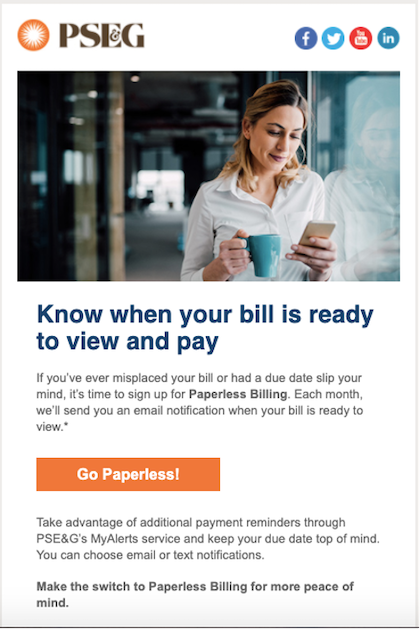
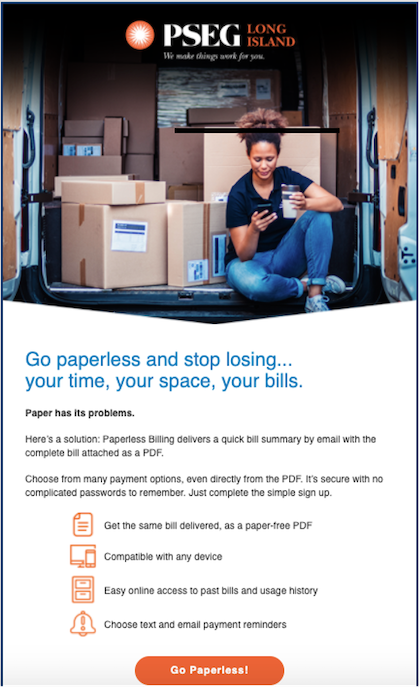
For many customers, paper bills are helpful reminders to ensure they pay their bill on time. Without a paper bill showing up in the mail each month, customers fear missing a payment. Encourage customers to go paperless by highlighting the convenience of email and text reminders.

Unlike paper statements, customers don’t have to be at home to receive them. In fact, they can be on a beach vacation and receive a text reminder that their bill is due. With alerts sent straight to a customer’s smartphone, paperless billing actually provides more effective reminders than old-fashioned paper bills.

Example of email encouraging customers to go paperless with payment reminder

It behooves energy utilities to promote the other useful features, including easy access to current and past bills in My Account. Nowadays, everyone is looking for ways to reduce paper clutter and simplify their lives. Your customers will appreciate this convenient option for keeping track of their bills. Instead of storing paper bills in a filing cabinet or desk drawer, electronic statements are available in My Account for safe recordkeeping. You can encourage customers to go paperless by promoting these useful, yet lesser known, benefits of ebill.

Example of email encouraging customers to go paperless by saving time

3. Showcase the convenience of ebilling

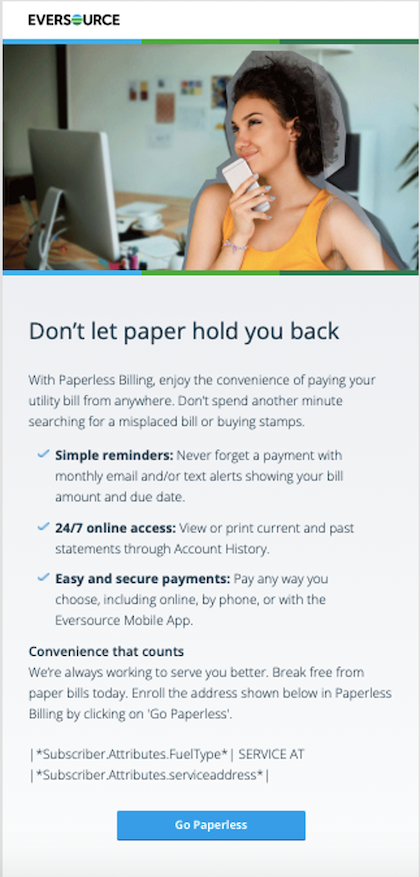
With our on-the-go schedules, everyone is looking for less stress and more convenience. One of the most popular benefits of paperless billing is the flexibility of “anytime, anywhere” online bill access.

Instead of waiting for a paper bill in the mail, customers can view their bill while waiting in line at a coffee shop or taking their dog for a walk. Emphasize the convenience factor in your email campaigns to encourage customers to go paperless, including the ability to view and pay their bill from any location.

Example of email encouraging customers to go paperless with convenience

4. Make enrollment easy and quick

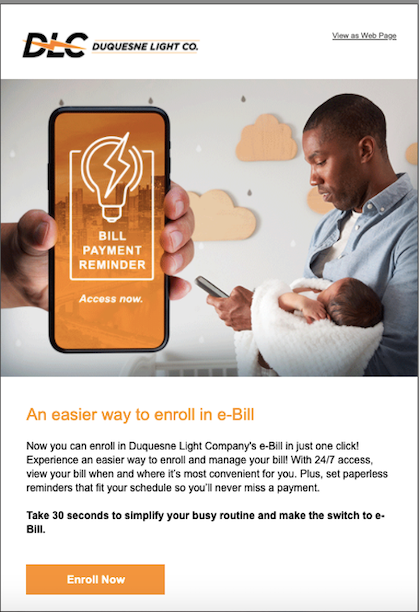
One of the biggest barriers to paperless billing adoption is a complicated enrollment process. Everyone is strapped for time in our 24/7 world — that’s why your utility needs to make ebill enrollment as streamlined as possible.

Even if customers are finally ready to make the switch, a long and complicated enrollment process can stop them in their tracks. To encourage customers to go paperless, we recommend creating a one-click enrollment on your website or mobile app. Also, be sure to highlight the ease of enrollment in your promotional campaigns. For example, use language such as “enroll in 30 seconds” or “you’re only one click away from e-Bill convenience.”

Example of email encouraging customers to go paperless with easy enrollment

5. Educate customers about the environmental impacts of paper waste

Environmental concerns are top of mind for residential and business customers alike. Your ebill promotions should remind customers that going paperless will not only reduce paper clutter in their homes and offices, but keep paper out of landfills as well.

Paper makes up 26% of total landfill waste, and account for 50% of the waste generated by businesses. By showcasing the impact of ebill on reducing this waste, your utility can go a long way to encourage customers to go paperless.

Keep in mind, not all customers are motivated by the environmental impact of ebill. In email campaigns, eco-friendly messaging should be subtle and mentioned along with other benefits like convenience or easy enrollment.

Break Barriers and Increase Conversions

While it can be a challenge to encourage customers to go paperless, it’s not an impossible task. With the right messaging, your energy utility can help customers replace old habits with new ones.

Get more of your energy utility customers to sign up for paperless billing with a digital engagement strategy from Questline Digital.

Paperless billing incentives are a tactical way to increase signups to your energy utility’s eBill or paperless billing program. In addition to engaging customers, incentives drive higher click-through rates (CTR) and conversions for eBill campaigns. 

What are paperless billing incentives?

Paperless billing incentives can vary, ranging from high-value prizes like tickets to a sports game or smaller giveaways for every customer who signs up for eBilling (for example, LED light bulbs and gift cards).

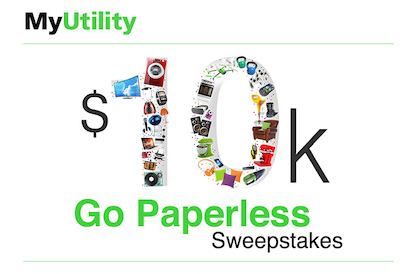
Example of Paperless Billing Incentives ad for sweepstakes

Questline Digital data shows that paperless billing promotional emails with incentives have a 17% higher open rate and 28% higher CTR than messages without incentives. Customers enjoy having the opportunity to earn prizes, especially after learning about the many benefits of paperless billing.

Still, even after identifying the right incentive, it can be daunting to build a campaign strategy that maximizes conversions.

Success starts with a subject line

An incentive-focused paperless billing email begins with an effective subject line that clearly explains the offer. If the giveaway is immediate, let your audience know by using language like “Claim your reward now.”

Follow these subject line best practices for paperless billing incentives:

  • Subject lines that clearly state the incentive reach 13% more of their intended audience compared to subject lines that only imply an offer.
  • Subject lines with “We’ll Pay Your Bill” in the title drive high open rates, but fewer click-throughs.
  • Conversely, subject lines with the word “free” typically do not perform well. This word is often associated with spam.

High-ticket prizes vs. low-cost giveaways

It’s best to test high-ticket and low-cost paperless billing incentives to see what resonates most with your utility’s customers. Consider having a mix of promotions included in your campaign strategy to connect with different customers and vary the giveaways.

Keep in mind that bigger paperless billing incentives do not necessarily mean bigger engagement. While large-dollar-amount prizes drive customer interest in opening promotional emails, that enthusiasm can sometimes be diminished through the contest-entry process.

The “cost” for entering into the drawing is an immediate conversion into paperless billing; this can create an unequal transaction where your customers are asked to give up paper bills for a small chance to win a reward.

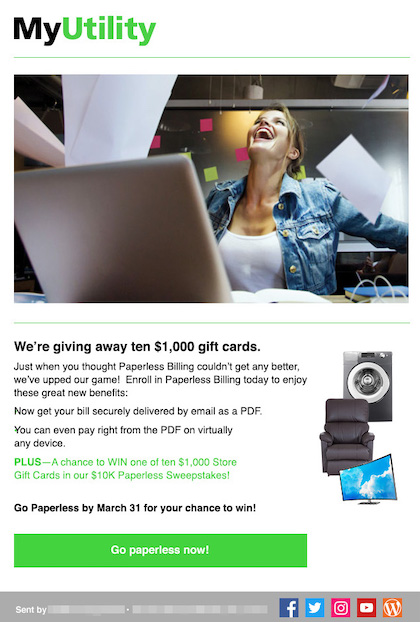
Example of Paperless Billing Incentives with Gift Card Contest

In comparison, we’ve found small incentives are often more effective because they have an immediate, guaranteed payoff. According to Questline Digital data, compared to a contest to win one big prize, small incentives for every customer have a 13% higher open rate and 82% higher CTR.

Based on an analysis of the paperless billing incentives campaigns deployed by Questline Digital, we have found:

  • Awarding a $5 gift card to all signups converts better than enter-to-win contests of $1,000 or more.
  • Products like LED light bulbs rank second among the best drivers of click-throughs.
  • Thermostats and smart home device giveaways are also top performers.
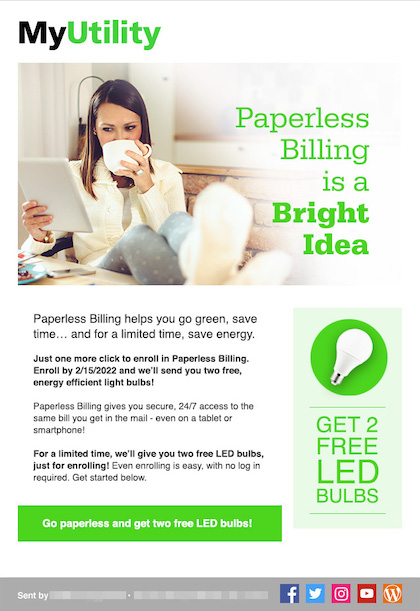
Example of Paperless Billing Incentives with LED giveaway

Make incentives easy to earn

Making the process easy to sign up for paperless billing is key to increasing conversions. In fact, one-click opt-ins into paperless billing programs increase conversion rates by 22%.

It should be equally easy to earn paperless billing incentives. Customers will appreciate a simple, one-click process to enroll in paperless billing, but the immediate question following signup is, “When will I get my prize?”

Make sure your utility is prepared to answer this question in detail. Share next steps with customers, including if you need to receive their mailing address for prize delivery, if they need to print a coupon or any other steps needed to redeem their incentive.

Make this process just as simple as enrolling and your customers will wonder why they didn’t make the switch sooner.

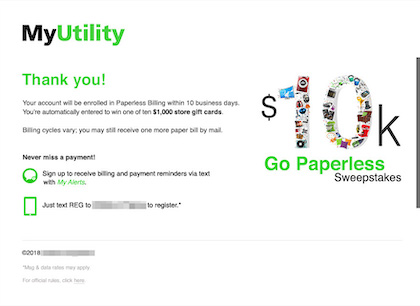
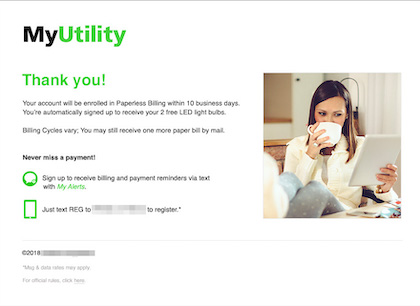
Example of Paperless Billing Incentives sweepstakes entry message
Example of Paperless Billing Incentives thank you message

The power of paperless billing incentives

Everyone likes free things. By offering paperless billing incentives to encourage conversions, customers are more likely to embrace the benefits of eBills.

Paperless billing incentive campaigns are also a great way to encourage re-enrollment from customers who may have unenrolled from past eBill programs. Maybe they unenrolled by accident or didn’t quite understand the benefits. Either way, an incentive-based campaign can be a perfect re-introduction.

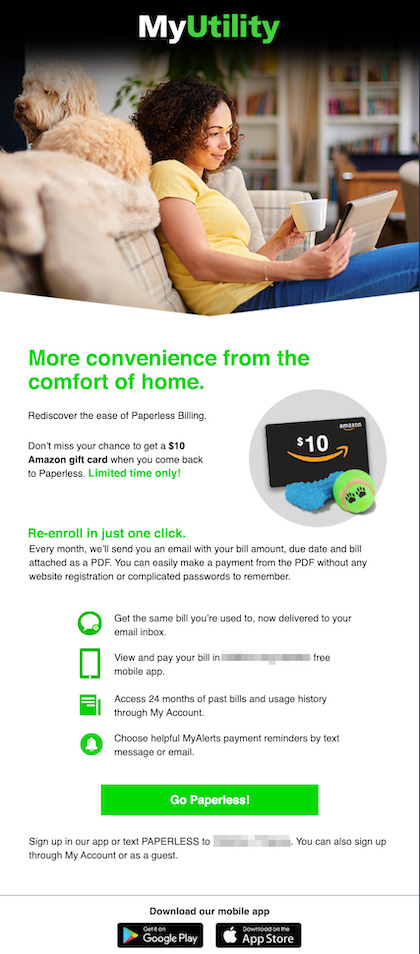
Example of Paperless Billing Incentives with Amazon Gift Card

Incentives provide a massive return on investment for energy utilities, saving operational costs every month for every paperless customer. That’s what we like to call a win-win.

Drive more paperless billing conversions with a digital engagement strategy from Questline Digital.